




Jules Bourbeau ’25
Managing Editor
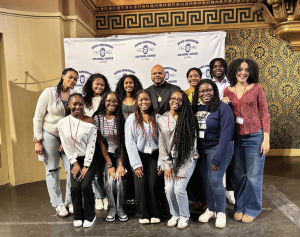
On Feb. 8, 2025, the Asian American Student Association (AASA) held their annual Lunar New Year celebration in the Washington Room of Mather Hall. When guests first walked in, they were welcomed by a selection of booths to explore, lining the walls of the room. At one, Reese San Diego ’25 sold prints of her artwork and offered her popular “Doodles for a Dollar” portrait-drawing commissions.
Trinity’s Japanese Department led a calligraphy station, in which students studying Japanese taught guests how to write the kanji symbol for “luck.” One of the students running the booth, Ashton Rivera ’26, told the Tripod, “You’re meant to hang it upside-down on your door to invite luck inside.” The Japanese Department is currently offering a course titled “Kanji, Script, and Calligraphy” (JAPN-203) that dives more deeply into the history and art of Japanese calligraphy.
Plates of Indian sweets covered the South Asian Students Association’s (SASA) table. SASA Freshman Representative Radhika Ramdas ’28 explained that these treats are expensive and difficult to find in the United States, so it was a special experience to have them here.
One booth was based around the popular television series “Squid Games,” and invited guests to play games featured in the show. However, these activities are not limited to the show, and have their basis in traditional games. Gonggi, or “five stones” was by far the most popular, with students attempting to toss a small plastic stone in the air and pick up another one before catching the first. Guests could also try their hand at neomgyeomeokgi, in which two players attempt to flip each other’s ddakji, a paper toy, by throwing them together. AASA Freshman Representative Khim Nguyen ’28 remarked, “It’s nice to see these games we played in childhood.”
Guests could pick up stickers and tote bags with a graphic of a snake designed by one of AASA’s public relations officers, Chanh Mai ’28. The snake marks the halfway point in the 12 year Chinese zodiac cycle. At the same booth, students could also express their appreciation for employees of Mather Dining Hall by writing cards to them.
There were also several booths for charitable endeavors: Isshori Gurung ’25 ran a bake sale to raise money for menstrual products for those in need. In addition, Trinity Environmental and Climate Justice, the Office of Sustainability and the American Cancer Society gathered funds for survivors of the fires in Los Angeles.
In the middle of the room stood a cherry blossom wishing tree. Guests could write their wishes for the new year on a piece of paper and tie it to the branches of the tree in the hope that it might come true.
At 5:30 p.m., the students of the Ju Long Wushu Chinese Martial Arts Training Center performed a lion dance, with two bright yellow lions jumping, twisting and greeting audience members. The talented young dancers brought their lions to life through blinking eyes and wagging tails. Lion dances are performed across Asia and Asian diasporic communities to invite good luck.
Food was then served, including a variety of Asian dishes: scallion pancakes, sesame balls, chả gà chiên and more. AASA sourced each part of the meal from local Hartford area restaurants.
As everyone ate, Assistant Professor of International Studies and Women, Gender and Sexuality Studies Shunyuan Zhang explained some of the history of Lunar New Year. The holiday began in China as early as 1600 B.C. but soon spread across East and Southeast Asia. Zhang also shared some of her favorite Lunar New Year traditions, such as reunion with family, going to the flower market and burning incense at temples. She then allowed members of the audience to share how they celebrate Lunar New Year. As such an old and widespread tradition, practices can vary greatly, even within China.
Then began the performance portion of the evening, which started with the students of Ju Long Wushu returning to the stage to show off their synchronized martial arts performance. A varied selection of singing, dancing, and instrumental performances followed, including a stunning rendition of “The Lights of China” sung by Sydney Yu ’25 and the Yale Fusion Dance Group’s snappy routine choreographed to K-Pop group aespa’s song “Drama.”
In between performers, AASA members invited the audience to participate in trivia, modeled after Jeopardy. Questions revolved around Asian culture, geography, and celebrities. After two rounds, the individual members of the winning team then competed against each other in a gambling game. The game mimicked bầu cua cá cọp, a Vietnamese dice betting game. The winner received $50.
In addition to the performances and trivia, AASA also raffled off several prizes. Those who were fortunate enough to have their number picked could receive gift cards for Peter B’s, a giant Valentine’s Day teddy bear or Trinity College merchandise, among other options.
The night ended with a tense game of biseokchigi, or “flying stone,” to decide who would win the grand prize of $150. Two lucky guests found red envelopes under their seats that recruited them to the competition. The participants tossed stones back and forth, trying to knock over their target.
In the end, only one person could go home with the grand sum, but the joyous festivities, community connections and beautiful performances ensured that everyone left with the sense that their new year was off to a fortunate start.

+ There are no comments
Add yours