Carlos Fonseca ’30
Staff Writer
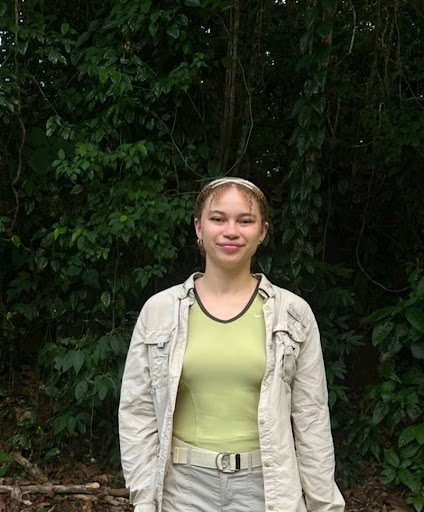
From studying bees on an island in Panama to painting landscapes and leading Trinity’s Caribbean Students Association (CSA), Yasmin Barnes ’27 has spent her college years pursuing interests that often take her beyond the classroom. A biology major with a passion for ecology and art, Barnes has embraced opportunities that have shaped both her academic interests and personal life. I had the pleasure of speaking with her about her research, experiences abroad, involvement at Trinity and her advice for younger students.
Barnes’ fascination with nature began during her childhood in Texas, where she often found herself observing insects and other wildlife. Her family’s Panamanian roots also exposed her to environments that encouraged her curiosity about the natural world. “I would watch [the insects] and then I would think to myself, what’s going on in their worlds?” she recalled. “I think I never lost that.”
At Trinity, Barnes has pursued this curiosity through research with Professor Benjamin Toscano, whom she began working with during her freshman year. Her research examines how predators influence aquatic ecosystems, particularly how predatory stoneflies affect smaller insects and algae growth. Barnes explained that her work involved constructing experimental equipment, placing it in streams and observing how organisms responded to the presence of predators. Her team’s findings suggested that the presence of predators could affect the behavior of smaller organisms and the growth of algae, with these effects persisting over time.
Her interest in ecology also took her to Panama, where she conducted research at the Smithsonian Tropical Research Institute under Dr. William Wcislo. Working on an island in the Panama Canal, Barnes studied bee metabolism and how social interactions might affect energy expenditure. Using specialized equipment, she measured the bees’ oxygen consumption and carbon dioxide production to better understand their behavior. The opportunity came after Barnes reached out directly to a researcher, something she encourages other students interested in research to try.
But Barnes’ curiosity isn’t limited to scientific research. During her junior year study abroad programs in Cambodia and Panama, she became increasingly interested in the relationship between people and their environments. These experiences also strengthened her appreciation for art, which she sees as another way to connect with the natural world. Barnes enjoys painting landscapes, particularly those that remind her of places she has visited. She also practices insect photography. Recently, she created a photography display featuring insects and plants from the native garden outside Trinity’s Life Sciences Center, hoping to encourage students to appreciate the wildlife around them. “I think art is a language to reach people beyond words,” she explained. When she isn’t painting or photographing nature, Barnes also enjoys psychological horror films, particularly “Hereditary.”
Another important part of Barnes’ Trinity experience has been her involvement in CSA, where she currently serves as president. She first joined the organization during her freshman year after a teaching assistant encouraged her to attend. As a student with Panamanian roots, she quickly found a sense of belonging within the group. “I really just fell in love with the group because it felt like home away from home,” she recalled. Barnes described CSA as an important part of her college experience, highlighting the friendships and leadership skills she has developed through the organization. As president, she hopes to maintain that welcoming environment for other students while celebrating Caribbean culture and strengthening the organization’s connection to the broader Hartford community.
Looking ahead, Barnes hopes to pursue a Ph.D. in ecology and evolutionary biology, focusing on native pollinators and sustainable food systems. She is also applying for international fellowships that would allow her to work with nongovernmental organizations before graduate school. Her experiences abroad have encouraged her to consider how scientific research can address environmental challenges while benefiting the communities affected by them. “I want to really make a systemic change and help people as much as I can,” she explained.
Reflecting on her time at Trinity, Barnes emphasized that some of her most meaningful experiences have come from unexpected friendships and opportunities. She recalled forming close relationships with students from countries such as Pakistan and Mongolia, people she might never have met otherwise. These connections, alongside her research and involvement on campus, have helped her find a sense of belonging at Trinity.
For underclassmen, Barnes encourages students to reach out to professors and take advantage of opportunities outside their comfort zones. She believes some of the most meaningful college experiences come from trying something new: “Do the random things, because those are the things you remember.”