





Maya Sasaki-George ’28
Staff Writer
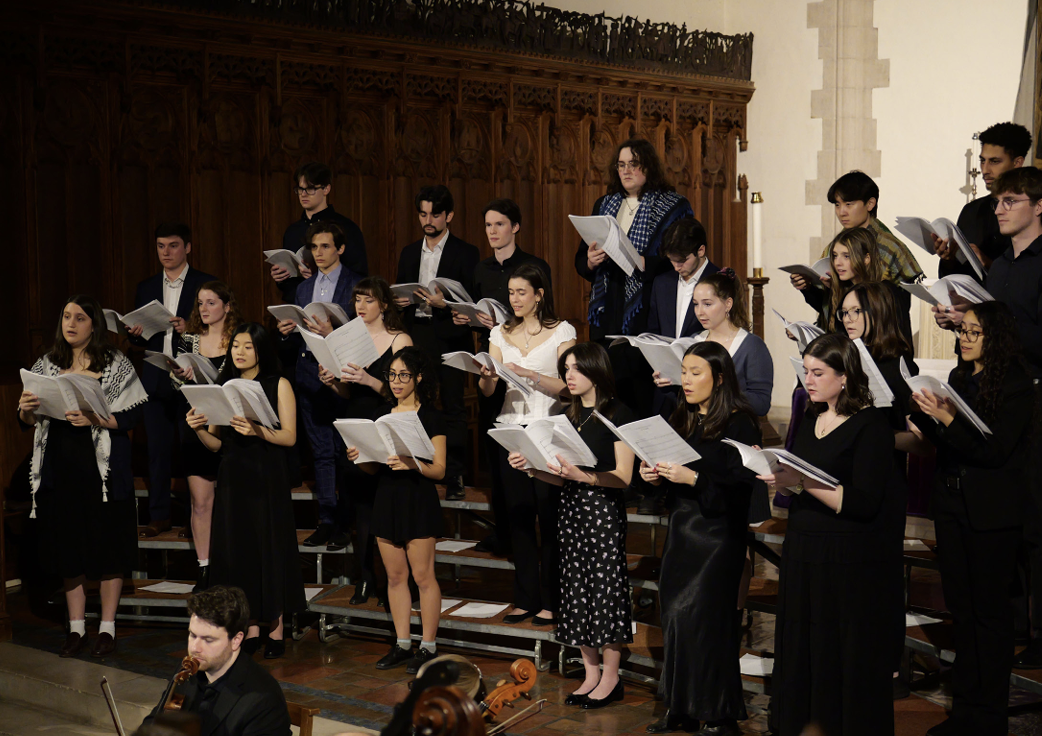
Founded in 1825, the Chapel Singers is the oldest student organization at Trinity College. To celebrate its bicentennial, the group performed a concert entitled “Music of Grief and Comfort” on March 12, 2025. The Trinity Tripod sat down with Trinity’s Director of Chapel Music and Artist-in-Residence, Christopher Houlihan ’09, for an interview regarding the performance and organization as a whole. On the night of the concert, a chilly, early-spring breeze was blustering through campus; cocooned in the dry, dusty warmth of the Chapel with music flooding every nook and cranny of the expansive room, I felt keenly aware that something truly special was taking place.
The concert was divided into three sections, beginning with “O Nata Lux” composed by Kerry Andrew, a piece performed fully in Latin, and “To the Hands,” a longer piece composed by the Pulitzer-winning Caroline Shaw. “To the Hands” sought to comment on internal displacement and the struggles of displaced individuals, repeating the lyric “I will be your refuge” as a means of providing comfort to both the displaced peoples to whom the song is directed, but also the audience in attendance. During the piece’s fifth movement, “Litany of the Displaced,” the Chapel Singers recited the statistics of the number of internally displaced persons in each country, their voices rising in cacophony as the numbers drastically increased. As described in the program, “[The statistics represent] people, some of whom may have legal refugee status, who have been displaced within their own country due to armed conflict, situations of generalized violence or violations of human rights.” The discordant instrumental music played during this portion of the piece, coupled with the singers’ impassioned recitation of such significant statistics created a compelling union of logos and pathos. Professor Houlihan was adamant that music as an artistic form could affect the audience’s absorption of information as well as their emotional reaction in a unique way. “I think a listener is left with an even deeper impression of these statistics, which can seem … very remote,” he explained. “When paired with music like this, it takes on a more immediate feeling.” I was interested to know why Houlihan selected this piece in particular: “I think it’s no secret that there is a lot of grief in this world—that we are living in a particularly turbulent and divisive time,” he said. “I am aware and conscious of the fact that Trinity students are part of that and are experiencing that themselves.” While “Music of Grief and Comfort” was by no means intended to be a political concert, Houlihan asserted his belief that “music needs to and always has had a role in responding to culture … and the very real things our community is going through.” “To the Hands” was followed by a beautiful organ number, “Rhapsody, op.17, no.1,” composed by Herbert Howells and performed by Elijah Morris ’28.
The third and final section of the concert was a piece entitled “Sacred Place” by the Jewish composer Alex Berko, performed in the structure of a Jewish liturgy; it included an opening and closing prayer, as well as a prayer for healing and a prayer for the dead. While technically non-denominational, the Chapel Singers have a history of singing primarily Christian choral music. “We’ve tried in recent years … to diversify the repertoire that we sing, both in terms of the composers’ identities [and by using] music that is more broadly sacred,” said Houlihan. “There’s a big tradition in classical music, and choral music in particular, of pieces based on the Christian liturgy — Bach, Beethoven, Mozart — writing requiems or masses, pieces for instruments and singers to sing Christian words,” he explained. “Berko wanted to, in a way, honor that musical tradition, but also pay homage to his own Jewish identity.” By diversifying the Chapel Singers’ repertoire in this way, Houlihan feels the group can reach a wider audience and broaden conceptions of what it means for a piece of music to be “sacred.” This piece in particular was focused on the environment and the physical world as a home for us all. There was a beautiful interplay of the low and high voices of the choir, evocative of waves lapping gently on a shore. “There’s a line we sing about birds and bees and butterflies, and you can hear the music buzzing and bubbling and flittering around,” described Houlihan. I was particularly moved by the soloists performing the third movement “Shema (To Listen),” Anna McAdams ’28 and Danny Lenois ’25. The piece concluded with three final poignant prayers and a long standing ovation.
I would describe “Music of Grief and Comfort” as a rousing success; as such, Christopher Houlihan is very optimistic about the organization’s future. “I think the Chapel Singers is a strong group and we’re going to continue to offer music to Trinity and the greater Hartford community that adds beauty to the world,” he said. “I talk about that with the choir a lot—that what we’re doing is important because beauty is really necessary in the world, especially in moments when we’re struggling.” When asked to speak briefly about the organization’s members and demographic make-up, Houlihan proudly told me, “We have students from all over the country, we have students that represent a wide variety of academic majors and departments, [and] we have students of many faiths. Their unifying force is a love of choral music and an interest in studying, sharing and performing difficult choral music.” To me, that says it all. I admire the group’s pursuit of an artistic expression that uplifts and unites the entire community, regardless of social, cultural or religious boundaries. There was a wide range of individuals represented in the concert’s audience—students coming to support their friends, frequent churchgoers, music lovers, parents, professors, community members and more—and it was very moving to see how the performance brought everyone together. I look forward to future concerts from the Chapel Singers and recommend other Trinity students do the same.
+ There are no comments
Add yours