





Lily Mellitz ’26
Executive Features Editor
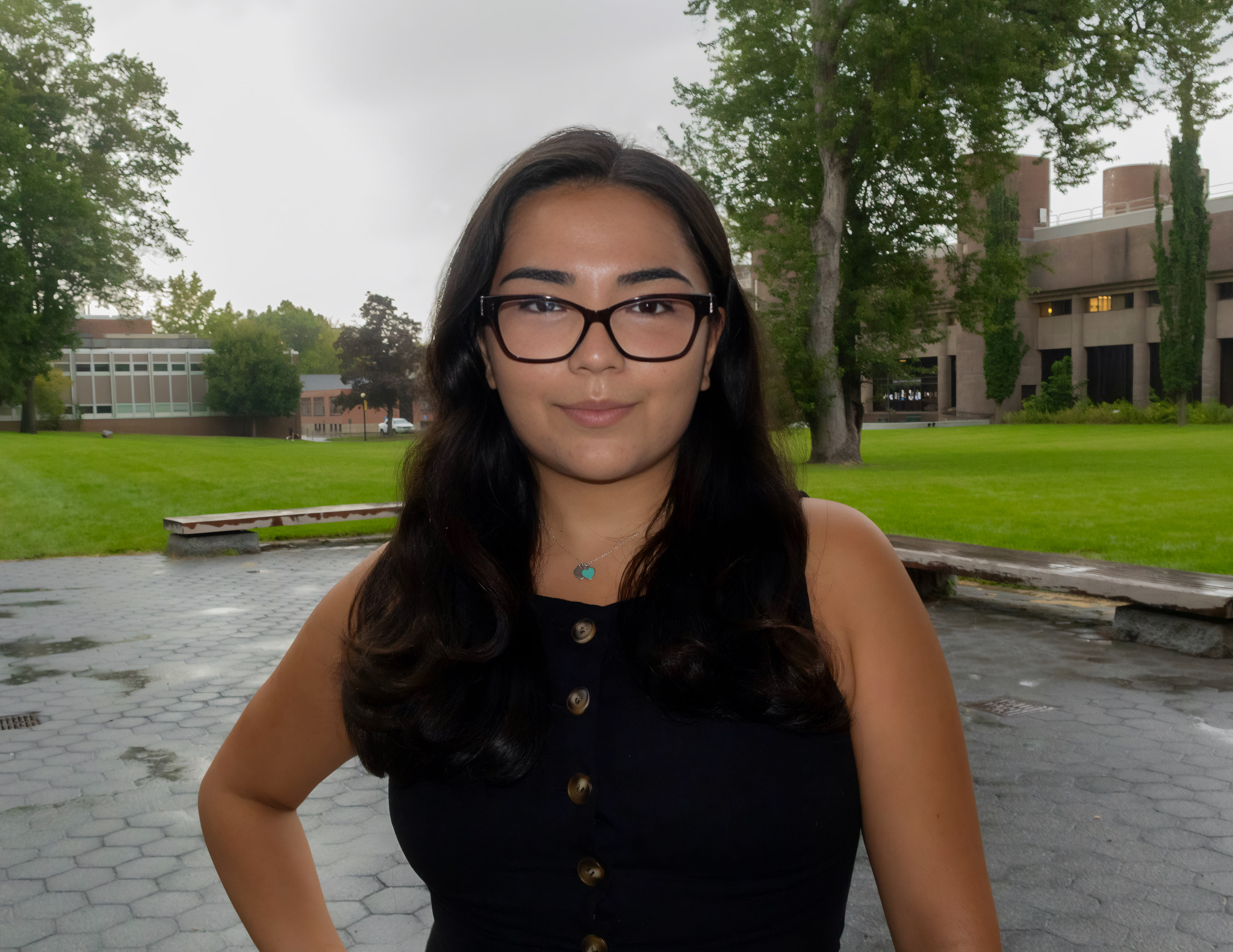
Makayla Cervantes ‘26, an economics major from Bristol, CT, has never been afraid to take the less straightforward path. A proud first-generation student, she entered Trinity with plans to major in political science. But after taking a Latin American politics class and joining the Community Action Gateway Program, she found herself “especially drawn to the ways economic policy intersects with politics and society,” and her focus shifted. “I’m so glad I made the switch to economics, though I still view my initial political science courses as the foundation of my interest in the field.”
The balance between theory and lived experience has guided Cervantes throughout her time at Trinity. She credits mentors like Professor Christopher Hoag, chair of the economics department, with helping her stay the course during a particularly challenging time outside the classroom. “His guidance is the reason I was able to continue my enrollment at Trinity and become the stronger student I am today,” Cervantes said. She also pointed to Professors Elise Castillo and Erica Crowley, who “provided [her] the foundation for the community events, research and relationships [she] hold[s] to this day.”
For Cervantes, economics is more than abstract models. “The department, alongside my research with community-oriented courses, has shaped the way I approach problems by combining theory with practice,” she reflected. “I now think more critically about the intersection between policy and lived experience, and how economic structures can both create opportunity and reinforce inequities.”
Such commitment to bridging classroom learning with real-world impact was most evident in her research with Professor Ibrahim Shikaki and Cooperate CT. As part of the Community Learning Research Fellows colloquium, she helped survey and map business cooperatives across Connecticut, a field that hadn’t been studied in decades. She even developed an interactive digital tool that allowed users to find and connect with cooperatives across the state.
“Meeting the individuals who built these cooperatives was inspiring,” she said. “It motivated me to continue this work through an independent study on worker efficiency and capital-raising initiatives in comparison to traditional investor-owned firms.”
Outside the classroom, Cervantes found her home at Trinity through La Voz Latina (LVL). “Coming from a predominantly white part of Bristol, CT, I rarely saw Latinos or Hispanics represented in higher education,” she shared. “I still remember how proud I felt seeing Latino professors on campus—it was the first time I had ever experienced that kind of representation in my life.”
Though Cervantes admits she was initially hesitant to even approach the club’s table at the Engagement Fair, her roommate convinced her to run in the first-year elections—and she won. “From that moment on, I found a family away from home.”
Since then, Cervantes has served as LVL’s community connectivity chair for two years before stepping into her current role as co-president. In these positions, she has redefined what it means for a cultural organization to connect with the community. Initiatives have ranged from hosting college prep sessions at local schools to organizing Café con Leche, a bilingual dialogue between Hartford residents and Trinity students about the College’s relationship with the city. For Cervantes, representation and connection have always been at the heart of her leadership.
Still, she acknowledges the challenges that come with navigating Trinity’s social landscape. “One of the biggest challenges I encountered was realizing how socially segregated Trinity can still be, even across cultural organizations,” she reflected. “The divisions across student groups are noticeable, and while Trinity’s student body is becoming increasingly diverse, this isn’t an issue that can be solved overnight.”
Looking ahead, Cervantes plans to pursue a career in private credit within the greater New York City area, building on her internships in corporate banking and private investment. One of her most formative experiences was interning at a small business investment company, where she saw firsthand how credit financing could support small businesses.
“I loved seeing how financial tools could be leveraged to support small business and drive economic growth,” she said. “I hope to continue working in this sphere, where my background in economics helps me connect private investment to broader societal impact.”
Her advice to younger students considering majoring in economics? “Your first two years serve as your foundation for your academic and professional career in fields like finance, so use this time to stay a little more focused on your studies and reach out for new internship opportunities whenever you have the chance,” she advised. “Hartford, alongside a wonderful food scene and history, provides students with many semester and summer internship opportunities that often work in our favor.”



+ There are no comments
Add yours