





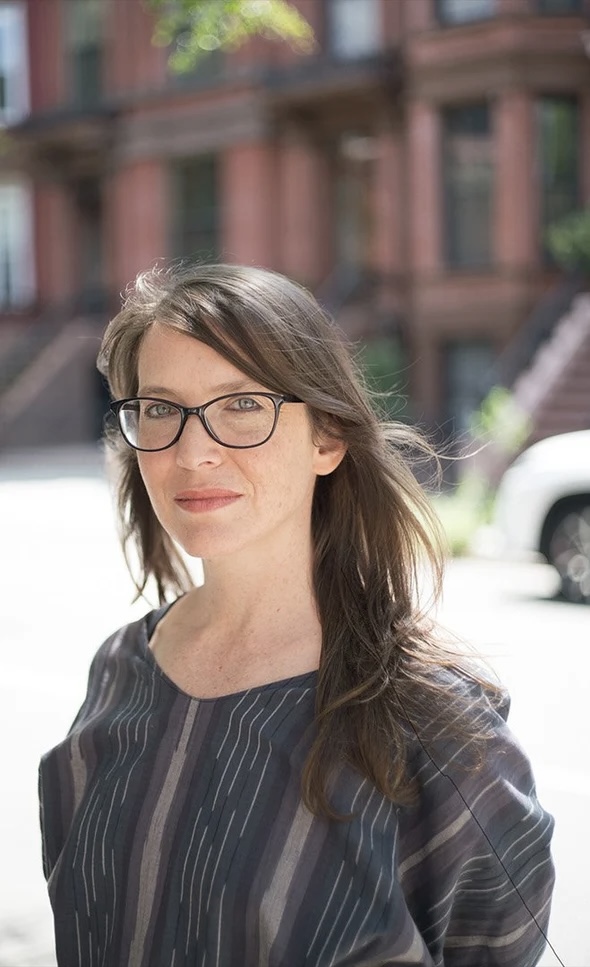
Lily Mellitz ’26
Executive Features Editor
Assistant Professor of Fine Arts at Trinity College and visual artistLynn Sullivan traces her connection to art back to Long Island, where she grew up just a train ride away from New York City’s museums.
“I found my way to art when I was very young, having the intuitive skill to draw from observation at a very young age,” Sullivan said. Her mother possessed many hand-production skills and her grandfather was a carpenter. Her father, who developed an unexpected love for art as a teenager despite having no formal background, brought her on monthly museum trips from the time she was a toddler.
“My capacity to make art was reinforced by my father,” Sullivan said. “His passion for art was passed on to me, and I haven’t stopped making and looking since.”
Sullivan later earned a dual degree — a BFA in fine art and a BA in cultural history — from Cornell University, followed by an MFA in combined media at Hunter College, where she focused on sculpture and video. But even before formal training, she had moments that sharpened her understanding of what art could be. One early memory stands out: speaking with a Guggenheim security guard about a Joseph Bueys sculpture at age eight that both startled and amazed her.
Sullivan’s artistic development has been shaped by a range of mentors and communities. She credits several faculty members, from sculptors to theorists, “all [who] taught students how to think, instead of how to make work in a particular way.” She also points to historian Michael Steinberg, her undergraduate history professor, whose “classes and guidance helped develop my capacity for critical thinking about art through history.” But her most formative environment may have been the MFA studios where she worked with others “morning to night” in massive studios in a giant, four-story scrappy industrial building.
“We talked about our work and art we were excited about,” she recalled. “The building community was immensely energetic and productive.
Sullivan’s upbringing also influenced her sensitivity to history, memory and place. “My upbringing [also] involved living abroad twice as my father taught in universities in Belgium and in Hungary, when the country was under Soviet influence,” she shared. “My family traveled around camping, shopping in markets and staying often outside tourism centers. The different spaces and architecture I moved through were very influential.” Back in the United States, long days on Long Island’s shoreline and upstate hiking trips offered another kind of education. Simply observing these environments was also important to her artistic thinking.
When asked about early works that helped her find her artistic voice, Sullivan pointed to her Cornell thesis sculptures made from steel concrete mesh—materials she salvaged from a lumber yard.
“The works enabled me to trust [that] I could communicate about complex subjects through materials, form, and space as much as I could with recognizable images,” she said.
When asked about pivotal shifts in her own practice, Sullivan mentioned a summer residency during her undergraduate years that marked a transition from painting to sculpture, prompted partly by discouraging experiences but ultimately opening new possibilities. And more recently, she has “Daughter of Sentence,” an exhibition at New Media Artspace, which is an intensely personal project.
“The idea and processes used to produce this exhibition build on my work from the last decade,” Sullivan said. “I do wonder if this show is a turning point and future works will pull directly from more personal experience.”
Like many artists, Sullivan cites the familiar challenge of preserving time, space and access to materials. Yet she remains deeply committed to both her experimental practice and her role as an educator. Teaching sculpture, she said, brings moments of inspiration from students who are new to the discipline but quickly grasp its possibilities. At a liberal arts college like Trinity, she appreciates being able to work with students throughout their whole artistic arc from freshmen to seniors.
“[I] get to see their visual and experiential language develop and shift,” she said. “When I ask a student to stop by and update me on their work in other classes, I am sincere! I am excited to see what they are making.”
A central part of Sullivan’s teaching philosophy is pushing students to move beyond their preexisting ideas of art. She encourages them to look widely and often — to observe everything around them, study art from all over the world, and stay critically engaged with their own work. “Art, even if it is abstract, is drawn from our critical engagement with the world,” she said. “Look, listen, think. Meet people, go to concerts, read. Our work is a product of our movements through our time and place in history. Out of these steps of learning, one can start to experiment with materials and build meaning.”
When asked about the future of visual art, Sullivan sees both freedom and responsibility. She came of age during a period when boundaries between mediums dissolved and technology rapidly expanded access. Today, she finds herself thinking deeply about the value of hand production and the critical thinking that emerges from process, material and meaning. “We need to safeguard this amazing and unique capacity,” she said. “And it makes me think teaching art is an increasingly important role.”
For young artists, Sullivan’s advice is practical and grounded: work daily, immerse yourself in ideas that matter to you, build a community and embrace the awkwardness and messiness of the artistic process. “Art comes out of a process of thinking and making, and a lot of trial and error,” she said. “It is a beautiful awkward struggle sometimes. Work iteratively, take notes, make tests, start things over, keep making changes. Work critically [and] periodically step away from your work and analysis it as if you weren’t the artist.”
For Sullivan, the practice of art — and the teaching of it — is inseparable from the world around us. Her career is a testament to the belief that art is built from observation, community, curiosity and a lifetime of seeing art in everything.

+ There are no comments
Add yours