





Alex Gervais ’28
Executive Opinion & Design Editor
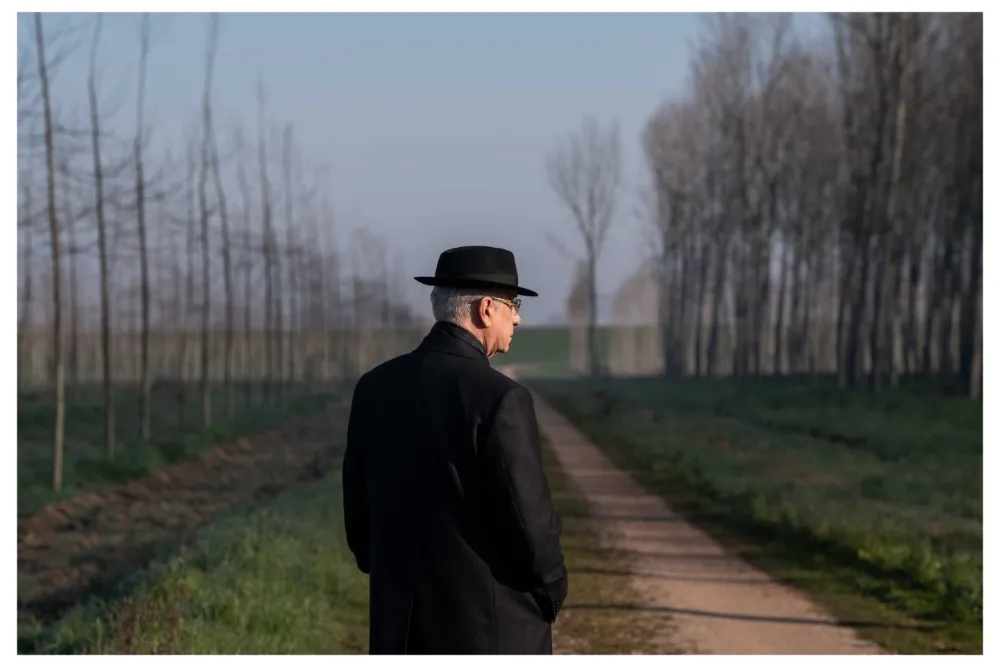
There’s a temptation that storytellers have to romanticize government in one way or another. Maybe that romanticization is Aaron Sorkin’s attempt to find unbounded, loving rationalism in America’s centrist politics of the late 90s in “The West Wing.” Maybe it’s Robert Redford’s satirically real portrayal of an idealistic, yet unmotivated Bill Mckay in “The Candidate.” Or maybe it’s Ari Aster’s “Eddington,” a crude depiction of crude local politics in a crude American town. Yet, it seems that Paolo Sorrentino’s “La Grazia” best captures the true essence of government: humanity. On Feb. 13 I attended Cinestudio’s screening of “La Grazia,” an Italian political drama that is about so much more than just politics. It’s a stunning character study into the mind of elder statesman Mariano De Santis, played by Toni Servillo (“The Great Beauty,” “The Hand of God.”) De Santis is stuck between a rock and a hard place politically, his catholicism and steady centrism pulling him to not sign a bill legalizing assisted suicide in the case of chronic, debilitating medical conditions. Essentially a lame duck president with six months left on his eight year term as the President of Italy, he must contend with the wishes of his daughter and closest advisor Dorotea, portrayed by Anna Ferzetti (“Diamanti,” “The Negotiator,”) and the long ago infidelity of his now deceased wife. As he navigates internal familial strife, he must also make sense of two pardon recommendations for murders of debilitatingly ill people by their life partners, a mirror of the legislation he is considering. Servillo’s performance is a gut-punch reminder of the humanity that public service entails. He brings not sadness to the role, but deep, genuine pain. The pain of a politician who is seemingly forever in limbo. The deep hurt of a widower still trying to find a way to cope. The disappointment of a father who feels he does not even know his own daughter even after spending nearly every day together. His performance is a refreshing reminder of who our politicians can be, not just talking heads dead set on raking the nation’s people over the coals of division, but instead mere mortals trying to make the best call they can with the cards they’ve been dealt. The film’s plot is brutally slow, but that’s how it must be. It seems to be intentionally boring at times, often the mundane is the focus: staff meetings, slow dinners, moments of silence, the underpinnings of an actual life in public service. There is no grand push for monumental legislation, no boisterous speeches calling the country into war, no tabloid scandal distracting from the art of governance. I’ve spent a lot of time around government, studying government, participating in government; if there’s one thing government is, it is not quick. The plot’s slow development is a brutally realistic mirror of the incrementalist, centrist, “capital L” Liberal politics that have been an intrinsic part of the European Union’s political life since the ’80s austerity era. Despite its pacing, the film still keeps the viewer engrossed throughout. It introduces exciting supporting characters like the over-the-top art critic Coco Valori, played by Milvia Marigliano (“Lord,” “On My Skin,”) and the overly ambitious Ugo Romani, played by Massimo Venturiello (“The Family,” “Marrakech Express.”) Their performances are exciting foils to the concrete stoicism that Servillo brings to his role. The film’s stunning aesthetics also help retain the viewer, each shot shrouded in the visual glory of Italy’s deep artistic past. The sets, designed by Ludovica Ferrario, are not sterile boardrooms and clean offices, they’re steeped in Renaissance sculpture, painting and architecture. They allow the characters to come to life in their spaces, building drama beyond just the performances of the actors. Sorrentino’s decision to make this a film about centrism was in itself a bold choice. When considering Italian politics, our minds do not go to restraint and responsibility. Instead we think of Mussolini, Caesar, Machiavelli; men who acted unilaterally and with impunity, entirely disregarding, even embracing, harm in the pursuit of power. Even Italian politics today embodies that spirit: far-right prime minister Giorgia Meloni is again leading the nation down a brutal path of culture war politics. It would have been easy for Sorrentino to tell that story, an off the rails leader grasping at straws, spiralling as their party and nation moved away from their radicalism, but that’s not what he did. He told the story of the real politics, the way things actually are and have been. For any person who wants a look into the minds of our leaders, the isolation, the elegance, the grace that comes with holding the highest office in the land, “La Grazia” is a good place to start.

+ There are no comments
Add yours