





Donald M. Bishop ’67
Alumni Contributor
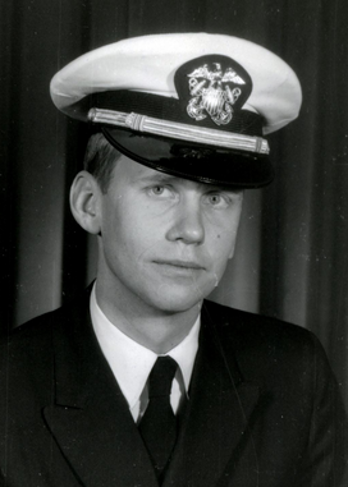
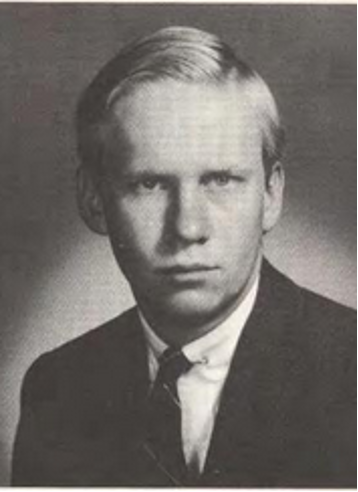
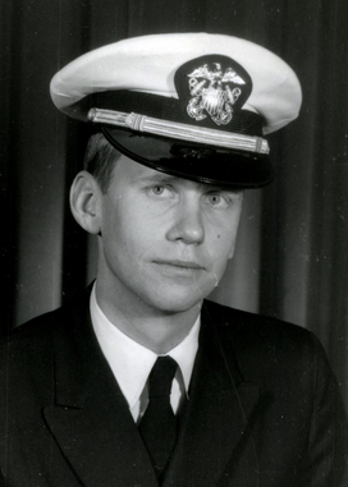
When “Skip” Schumacher of Trinity’s Class of 1965 passed away in 2018, he was a retired banker and financial advisor in St. Louis. But he merits recognition as one of the College’s most courageous alumni. A Navy officer held as a prisoner of war in North Korea, he was beaten and tortured during eleven months in 1968. Yet he steadily upheld the crew’s unity and the leadership of his ship’s captain.
Skip came to Trinity in 1961 after graduating from St. Louis Country Day School. He majored in religion. A member of St. Anthony Hall, he was co-editor of the Ivy.
All Trinity men in the 1960s faced the draft. Schumacher’s father was a proud Navy veteran of World War II, so after graduation Skip entered the Navy’s Officer Candidate School at Newport, RI. Commissioned and trained, he sailed on the USS Vega (AF-59), a stores ship. It carried cargo, equipment, and refrigerated items to Vietnam from the Philippines and Taiwan, conducting both underway and in-port replenishments. He qualified as an Officer of the Deck for independent steaming, authorized, he wrote lightheartedly, “to drive a ship as long as there is no other ship in sight to run into.”
Unexpectedly, he was sent to the USS Pueblo (AGER-2) in late 1967. This old cargo vessel, 187 feet long, had been reconfigured for a Cold War mission, electronic surveillance. Publicly, it conducted “environmental research,” and its crew included two civilian hydrographers, but thirty sailors and Marines in a Special Operations Detachment monitored electronic transmissions and reported them to intelligence commands in Japan, Hawaii, and the Pentagon. Eighty-three men were aboard for the ship’s first operational mission, surveillance off North Korea.
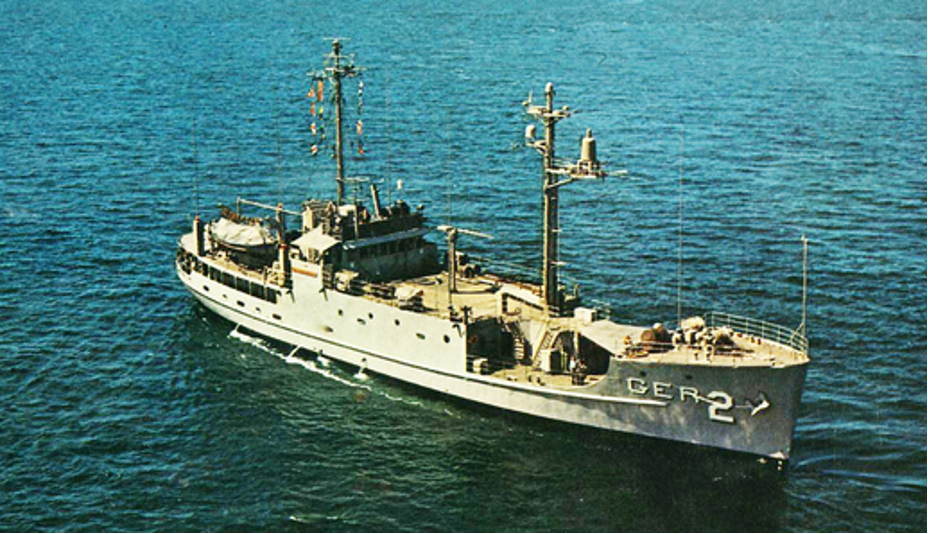
Schumacher was the vessel’s Operations Officer, communications officer, and First Lieutenant, third in command, sailing the ship and maintaining its decks. Each day he prepared the ship’s report – intelligence summaries and positions. He was 24.
In late Jan. 1968, 31 North Korean commandos passed through the Korean Demilitarized Zone (DMZ) to attack the Blue House in Seoul. Members of the team never reached the executive mansion; all but two were killed in fights with the Korean army and police from Jan. 21 to Jan. 29.
This news was not shared with the Pueblo, and on Jan. 23, while the ship was off Wonsan harbor in international waters 15.8 nautical miles offshore, the North Korean Navy sortied two submarine chasers and three torpedo boats to seize it.
Schumacher was on the bridge with the captain, Commander Lloyd Bucher. North Korean fire swept the ship, the rounds easily passing through its aluminum sides. During the engagement, one member of the crew was killed, and others were wounded. The Pueblo was armed with only two .50-caliber machine guns, exposed and unarmored, covered by tarps that were likely frozen. Captain Bucher judged that any crew member sent to man the guns would surely be killed.
The desperate hours off Wonsan offer a striking portrait of the extreme stress of naval command and how officers must lead and make decisions in spite of surprise, confusion, shock, panic and death.
Hundreds of pounds of classified documents had to be destroyed by burning because any material simply tossed overboard in the shallow waters could be recovered by divers. His uniform stained by the blood of a dying sailor, Schumacher moved between the bridge and the Special Operations Detachment, ordering panicked sailors to destroy equipment and burn documents. There were too many.
Over several hours, Captain Bucher tried to sail for the open sea, but the faster North Korean ships kept the vessel surrounded, fired and wounded more of the crew, and readied boarding parties. Judging the lives of his crew were more valuable than the ship, Bucher surrendered. It was boarded and taken to Wonsan.
Schumacher recalled, “For the Pueblo, the silence from our shore-based commanders was deafening. Despite excellent online, fully encrypted, teletype-based resources and prepared reports from the Pueblo, no instructions were received. The only navy trying to communicate with the Pueblo was North Korean.”
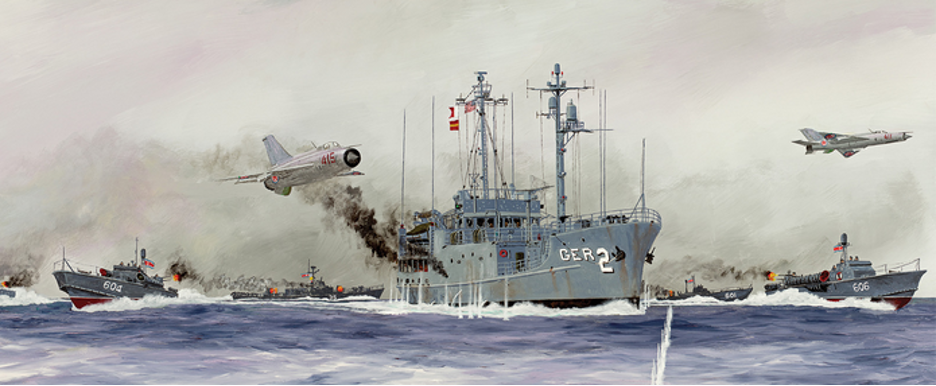
The January weather was freezing when the Pueblo reached Wonsan. Members of the crew were held in unheated cells with no food, and interrogations began. All knew they should give only name, rank, and serial number to their captors, but threats of execution and continual beating, punching, kneeing, 2×4’s, rifle butts and kicking ribs, faces, knees and heads day after day sapped their resolve.
Schumacher soon learned that the North Koreans had his personnel file — so they knew his service history — and copies of all the daily reports he had sent from the ship. They already knew many of the secrets the crew should not divulge. He delayed and dissembled as long as possible, but in the end, he, along with Captain Bucher and all the crew, signed “confessions” and statements largely dictated by their captors. Consistently, however, they did their best to protect intelligence secrets.
The violence waxed and waned over the weeks, and throughout the eleven months of their captivity, guards amused themselves by more kicking. Gradually, however, the North Koreans eased up, in time allowing members of the crew to gather and exercise.
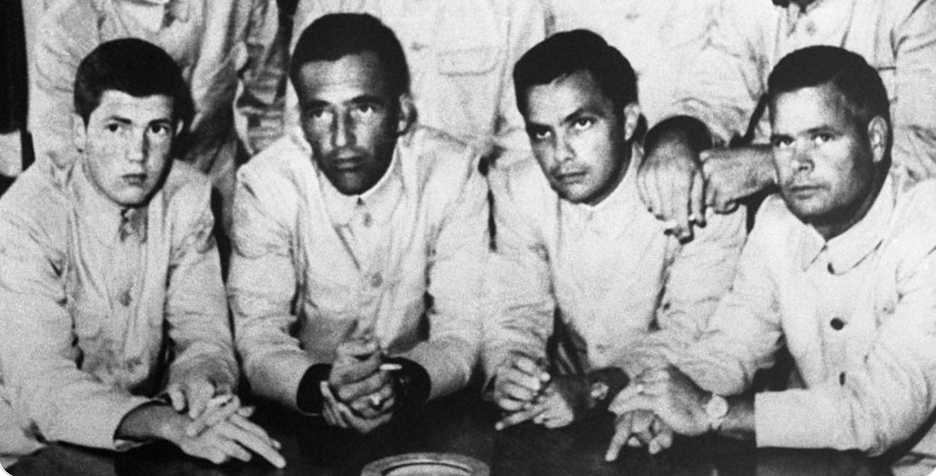
They also released posed photos to the international press. When their interrogators asked why so many members of the crew extended their middle finger, the Americans said this was a “Hawaiian good luck symbol.” Eventually, their captors learned from reading American media the real meaning of the gesture.
Having lost face, “Hell Week” followed — “a ten-day-long wave of brutal beatings and torture. I ended up with a couple of severely bruised ribs, one black and swollen eye, and large bruising and swelling around my left ear and head,” Schumacher wrote.
When their captors demanded one more “final statement” from Bucher, he and Schumacher wrote it together with additional creative input from members of the crew. Here’s the initial paragraph:
“A final confession in anticipation of leniency for my crew and myself for the heinous crimes perpetrated by ourselves while conducting horrible outrages against the Democratic People’s Republic of Korea for the purpose of provocating and annoying those stalwarts of peace-loving humanity. The absolute truth of this bowel wrenching confession is attested to by my fervent desire to paean the Korean People’s Army Navy, and their government and to beseech the Korean people to forgive our dastardly deeds unmatched since Attila. I therefore swear the following account to be true on the sacred honor of the Great Speckled Bird.”
Bucher and Schumacher chose the word “paean” because it could be pronounced “pee on.”
Bucher later wrote, “Skip was by far our most skilled man with words. His theological studies had given him a command of biblical language which, combined with his sharp wit, resulted in long-winded flowery verbosity signifying absolutely nothing.”
After the United States signed a false statement that U.S. government “shoulders all responsibility and solemnly apologizes for the grave acts of espionage committed by the ship . . . after having intruded into the territorial waters of the Democratic People’s Republic of Korea,” the crew was released on Dec. 23, 1968, crossing Panmunjom’s “Bridge of No Return.” Schumacher had lost more than 40 pounds during his time in North Korea.
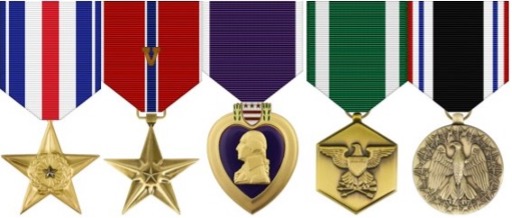
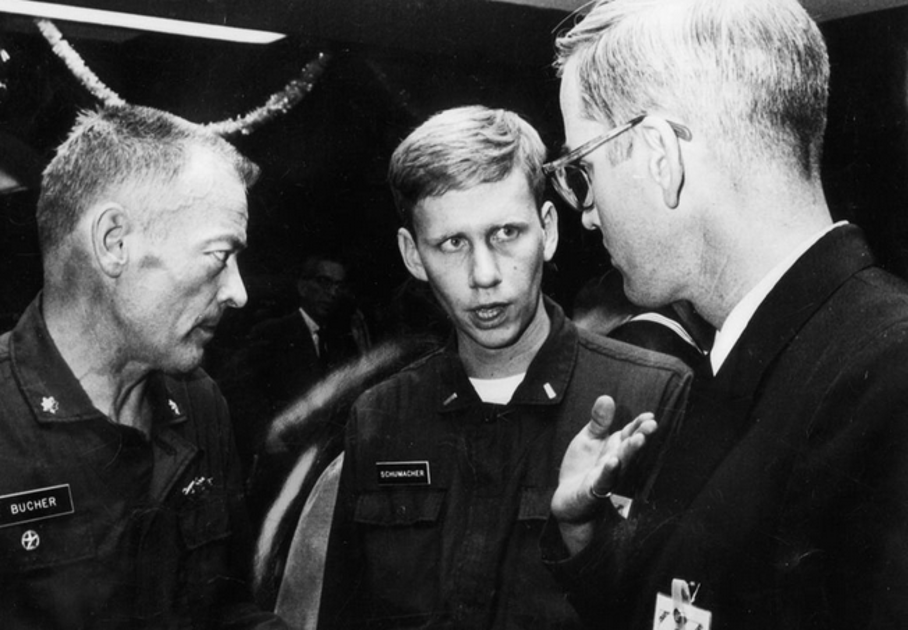
After a long naval inquiry on the loss of the ship, Schumacher left the Navy. He earned an MBA at Harvard and first worked for the family’s insurance business in St. Louis. He became a trust officer for Boatman’s Bank, later acquired by Bank of America. He formed a financial advising firm. He was his wife’s caretaker through her last years with dementia, and he succumbed to pulmonary cancer in 2018.
In his book, Commander Bucher called Schumacher “my outstanding operations officer and valued friend.” Their friendship was fostered on a warship’s bridge and in a dark prison.
For more: Schumacher’s Bridge of No Return, is a relatively low-key account. (He recalled Trinity on p. 38.) Commander Bucher’s My Story and the account by Executive Officer Edward Murphy, Second in Command, proved the two were not a mutual admiration society. See also Schumacher’s article, “Hell and Back”, a video of the ceremony honoring his Naval History Article of the Year and a Library of Congress interview.



+ There are no comments
Add yours