Kashmala Khan ’29
Managing Editor
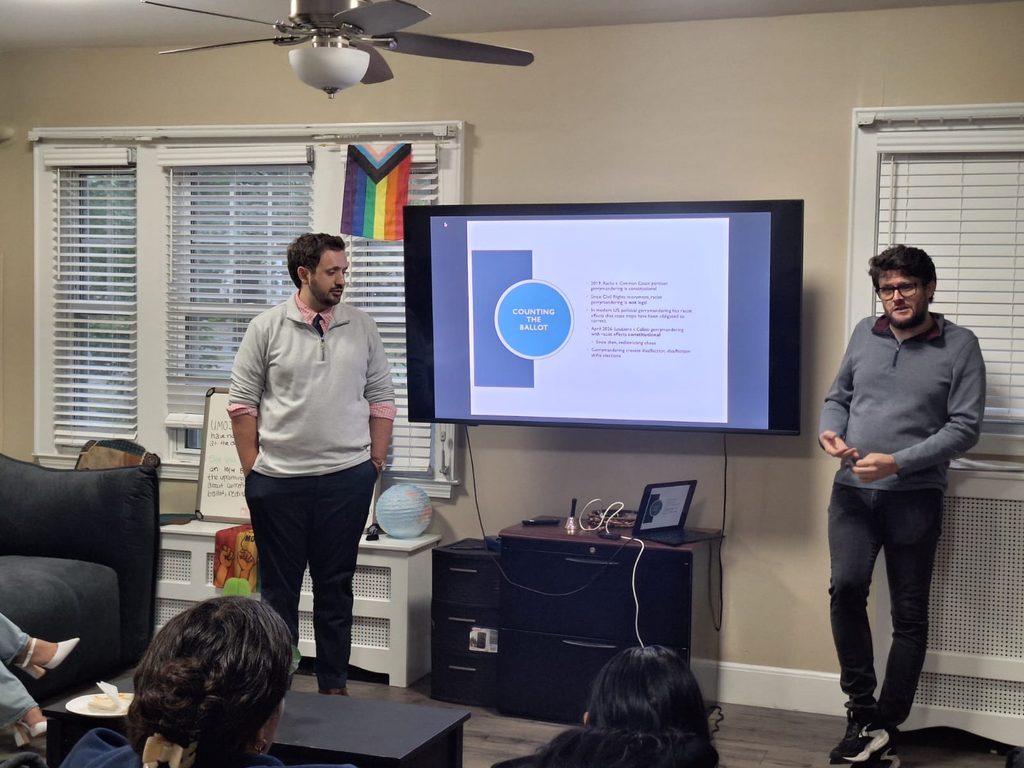
As the 2026 midterm elections approach, Trinity College students gathered Sunday evening for “Why Voting Matters,” the first event in a week of National Voter Education Week programming focused on voting rights, election administration and the legal challenges shaping the upcoming election.
Held at UMOJA on Oct. 4, the event featured Professor Shane Gleason and Professor Evan Turiano of the Department of Public Policy. The week’s programming is being organized through collaboration between Trinity’s Department of Public Policy and Law, Department of Political Science and Department of American Studies, as well as with TrinVotes!, WGRAC, CHER and Multicultural Affairs, providing voter education and engagement resources.
TrinVotes!, Trinity’s nonpartisan campus civic engagement initiative, was also on-site at the event, providing students with information and resources related to voter registration, identification requirements and voting deadlines.
Gleason opened the discussion by emphasizing that voting remains consequential, even in elections that may appear predetermined. “Even if you disagree with me, I want you to vote,” Gleason said. “And the reason I want that is because voting’s powerful.”
Drawing on his experience working as a political organizer for the AFL-CIO during the 2008 election, Gleason described grassroots organizing and efforts to increase voter turnout. He also discussed the history of voting rights in the United States, emphasizing that access to the ballot has not always been guaranteed. Referencing civil rights leader and former U.S. Rep. John Lewis, Gleason described voting as “the most powerful nonviolent tool we have in a democratic society.”
Gleason also focused on the importance of youth participation. He argued that politicians are more likely to pay attention to groups that consistently vote, while lower youth turnout can make issues important to younger generations easier for politicians to overlook.
Professor Turiano then turned the discussion toward contemporary legal challenges surrounding elections. He divided these challenges into two broad categories: disputes over how ballots are cast and disputes over how votes are counted. Among the issues discussed were voter registration lists, mail-in voting, redistricting and partisan gerrymandering. Turiano explained that although voter fraud frequently features in political debates, the actual risk of widespread fraud is extremely low. However, he argued that confusion surrounding election rules can still have significant consequences.
“Confusion can be enough to achieve the ends of the people doing these things [campaigning],” Turiano said, explaining that uncertainty about voter eligibility or ballot procedures could discourage people from participating. The professors also discussed recent federal efforts involving voter registration databases and mail-in voting, as well as ongoing litigation surrounding those policies. Turiano encouraged students to check their voter registration, and for those voting by mail, to request and submit their ballots as early as possible. The conversation later expanded to international students at Trinity. In response to a student question about the role international students can play in political conversations, the professors encouraged students to share their perspectives and engage with people around them while remaining aware of the legal boundaries surrounding political participation for noncitizens.
For Yasmin Saroufim ’30, the discussion provided a useful introduction to an otherwise complicated topic. “I thought it was really useful,” the student said. “Even though I can vote, I’m not very well-versed on it, but I do know what’s going on in the government, so this really helped.” The discussion was the first of several National Voter Education Week events at Trinity. Upcoming programming includes voter education tabling in Mather Hall on Oct. 6, a screening of “People vs. Politics” on Oct. 7 and “Popcorn & Polls,” featuring a screening of “Suffragette,” on Oct. 8.