Talia Cutler ’27
Editor-in-Chief
A page found in Trinity’s Watkinson Library was recently confirmed as a rare, previously unrecorded 15th-century printing connected to associates of Johannes Gutenberg, inventor of the printing press.
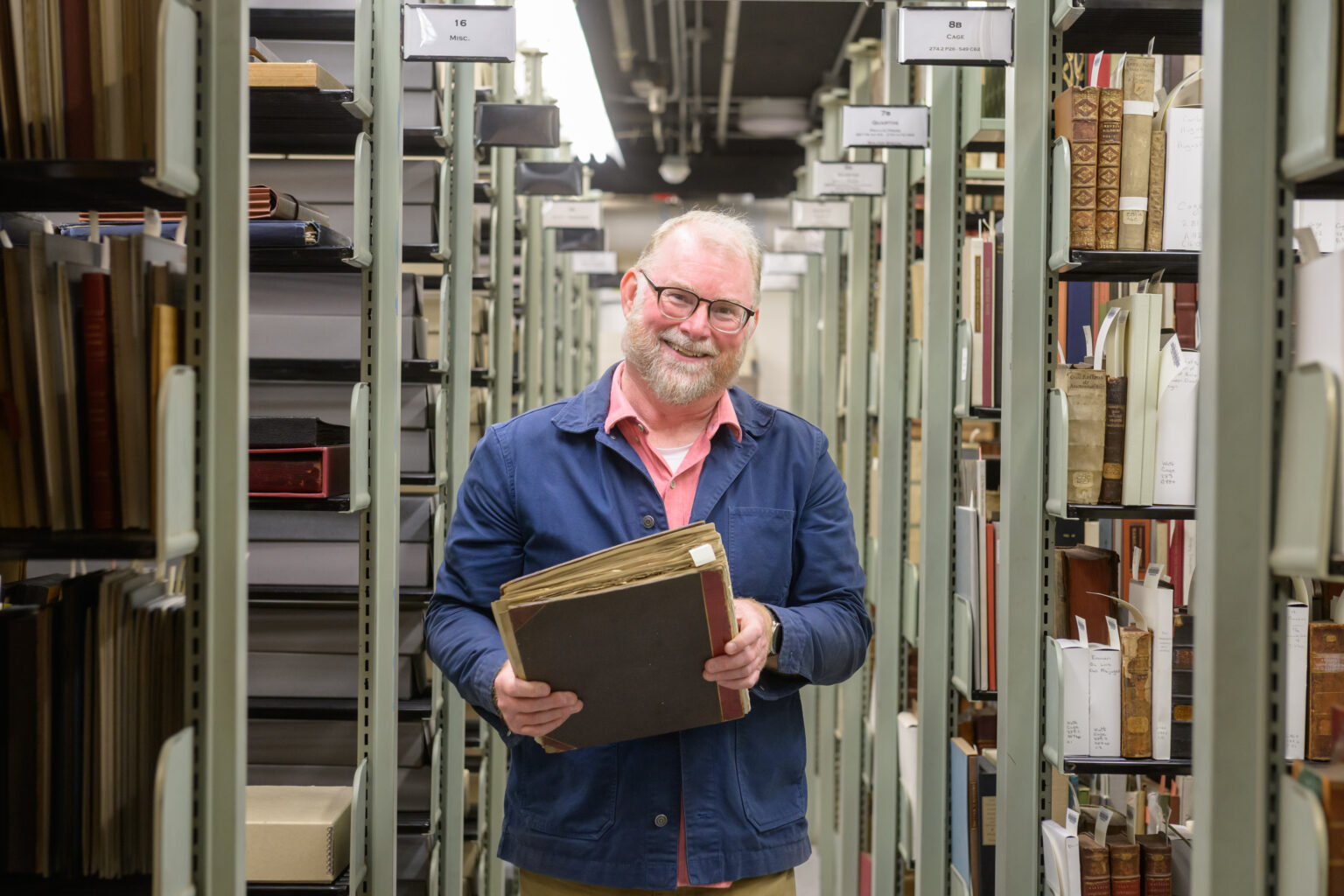
The paper is a proof page of an early schoolbook used for teaching Latin, first written by Aelius Donatus. “This particular edition is one we have not known about until now,” the Watkinson Library’s Rare Books and Special Collections Librarian Eric Johnson-DeBaufre told the Tripod.
The page was discovered in the fall of 2025 in a scrapbook devoted to pieces of binding waste collected by William Cowper Prime, founder and chair of the Art History Department at Princeton University and the first vice president of the Metropolitan Museum of Art. He was also the brother-in-law of the first librarian of the Watkinson library, James Hammond Trumbull. When Prime died in 1905, he left these books to the Watkinson library, where they have sat in storage conditions ever since.
When library assistant Celia Lanza ’26 found the page while cataloguing the archives last year, she thought the page and other scraps looked like “trash.” Eric Johnson-DeBaufre has worked at the Watkinson library for seven years, and recognized the “trash” as something special. “All type has particular characteristics. If you’ve looked at a lot of these things, your eye develops.”
Last summer, Johnson-DeBaufre was enrolled in a rare manuscripts class at Princeton University, where he studied manuscripts and proof pages like the one discovered in the library: “The first thing I thought was that I’ve seen this ‘P’ before,” Johnson-DeBaufre said of the germanic gothic type.
This print was by Foust and Schӧffer, friends of Johannes Gutenberg, inventor of the printing press and namesake of the rare and incalculably valuable Gutenberg Bibles. The page is likely from the beginning of printing in western Europe.
Manuscripts this old are typically found in fragments — a complete page is an exceptionally rare find, according to Johnson-DeBaufre. “In the United States, this doesn’t happen, […] the idea that we could find something from this period of printing in America is unheard of — astonishing […] No one knew some of the incredible things that were inside these scrapbooks,” he said, gesturing at the collection of William Cowper Prime’s books in front of him.
The Watkinson Library was founded in 1858 but did not move to its current location at Trinity College until 1951. Since then, the library collects, preserves and catalogues rare books and art. The proof page, Prime’s scrapbooks, and other rare prints and books are available to view by appointment in the Watkinson Library for anyone at Trinity College. “My favorite thing about working in the Watkinson is the students,” said Johnson-DeBaufre. “I love when someone comes in and gets excited about something in our collection.”
The proof page is just one of many rarities housed at the Watkinson, including a proof print of Durer’s “4 Horseman of the Apocalypse,” leaflets of the Gutenberg Bible and James Audubon’s exceedingly rare “Birds of America.” “We have stuff in our archives only seen in museums,” Johnson-DeBaufre told the Tripod. “There are always new things to find out.”