





Hannah Smith ’26
Executive Arts & Entertainment Editor
For the month of September in memory of his death, Cinestudio is celebrating the works of Akira Kurosawa, a Japanese filmmaker who is widely considered one of the greatest auteurs of all time. His career stretched from the final years of World War II into the early 90s. He received numerous accolades and nominations for his contributions to Japanese and global cinema, including the Academy’s Lifetime Achievement Award in 1989. Within his lifetime, he directed and wrote over 30 feature films of great renown including “Throne of Blood,” “Rashomon,” “Seven Samurai” and “High and Low,” the films Cinestudio will be screening over the next month.
From Sept. 4 to Sept. 6, “Throne of Blood” was shown. “Throne of Blood” is an adaptation of Shakespeare’s “Macbeth” set in feudal Japan. The film begins with two samurai warriors returning from war. On their way home, they run into a mystical woman in the woods who tells them their futures. They think nothing of it until the first prediction comes true. One of the samurai, Washizu—the Macbeth character—was prophesied to move in on the position of his lord upon his death. Washizu’s wife, Asaji who takes on the role of Lady Macbeth, poisons her husband’s mind into believing it would be best to kill his lord so that he doesn’t have to wait for his eventual undoing to gain total power. The film is cinematically striking, utilizing elaborate set designs and practical effects to make the audience feel like they’ve jumped through time back to 16th-century Japan. The final scene is an expertly choreographed fight scene that will shock you to your core. “Throne of Blood” plays with themes like fate and power, staying true to Shakespeare’s work of “Macbeth” while reimagining it in a way that is truly unique and will have you on the edge of your seat from start to finish. If you missed the screenings at Cinestudio, you can stream “Throne of Blood” on HBO Max.
From Sept. 11 to Sept. 13, Cinestudio will be showing “Rashomon.” This film is far from feel-good, but it is masterfully told, taking the audience through four different points of view of the same event in a courtroom drama style. In the end, you still don’t know who’s telling the truth, but by that point you almost don’t even care anymore. “Rashomon” begins with a man traveling through the woods when he stumbles upon a dead body. The four characters involved explain what truly happened that day, but it’s obvious they’re all constructing a story that is far from reality. The baseline of the events are the following: a woman and her husband are making their way home when a bandit comes along and sexually assaults the woman while her husband is tied to a tree until his eventual death. First, the bandit tells his story. Next is the wife, then the husband who is speaking through a medium. Finally, the man who found the body tells his truth. The truth is never definitively determined and, by the end, you are left with little to no faith in humanity. The structure and storytelling of “Rashomon” is one of a kind, incorporating various genres like action, thriller, crime and drama into one film. As a warning, this film involves sexual assault and suicide.
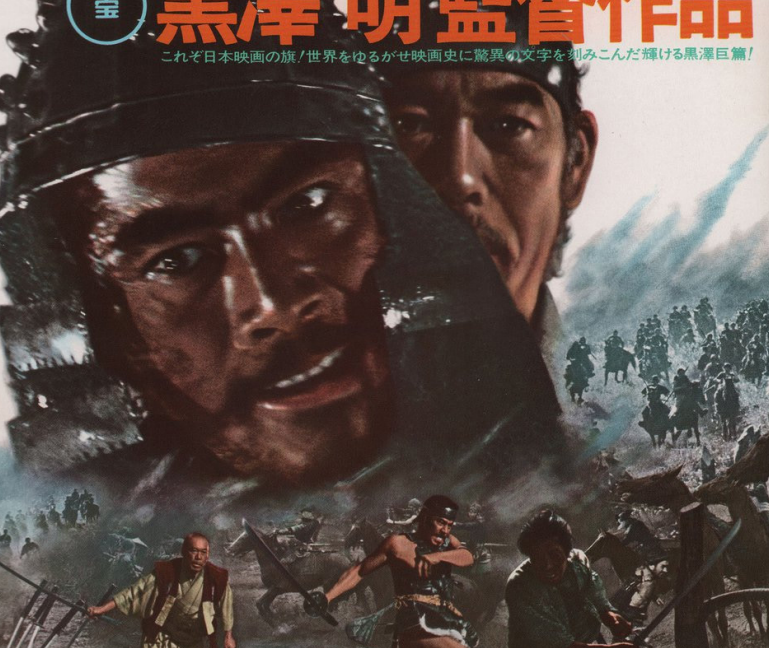
“Seven Samurai” will be screened from Sept. 18 to Sept. 20. “Seven Samurai” is an epic cinematic experience in every way. A small village in 16th century Japan is continuously being attacked by a group of bandits who steal their goods and vandalize their homes. The townspeople decide they need help or they will lose everything they have, so they send a young man out to the city to assemble a team of samurai, seven in all, who will defeat the bandits and save their home. This accumulates into a massive battle between the bandits, the villagers, and the samurai that is unlike anything I’ve ever seen. The scale on which “Seven Samurai” is filmed makes it seem like it had a production budget the size of a Marvel movie. This film is monumental with a runtime of just under three and a half hours, but it keeps you engaged every second. The last thing I’ll say is that “Seven Samurai” is one of my personal all time favorite films if that encourages you to get to the theater.
The final film of the Cinestudio-Kurosawa saga is “High and Low,” which will be shown from Sept. 25 to Sept. 27. “High and Low” is entirely different from the previous three Kurosawa films in that it is set in the 20th century and focuses on current, albeit over 60 years ago, Japanese crime plots with themes of social hierarchy, commercialism and economic divide. Adapted from Ed McBain’s novel “King’s Ransom,” this film noir centers around an ultra-rich industrialist family who falls victim to a dangerous kidnapper. When the kidnapping goes wrong, the film emphasizes the class disparity in Japan and the brutality of man, forcing you as the viewer to look within yourself and consider what you would do in such cruel conditions. This cop thriller is suspenseful and thought provoking, aligning with the rest of Kurosawa’s incredible filmography.
You don’t have to be a film major to enjoy Kurosawa’s films. If you’ve ever seen George Lucas’ “Star Wars: A New Hope,” Quentin Tarantino’s “The Magnificent Seven” or “Django Unchained,” Bryan Singer’s “The Usual Suspects” or Sergio Leone’s “A Fistful of Dollars,” then you’ve seen movies that were heavily influenced by Kurosawa films, some even reimagining his plots for their own films. Did you watch “Hoodwinked!” or “A Bug’s Life” as a kid? “Hoodwicked!” follows the same structure as “Rashomon” and “A Big’s Life” is a retelling of “Seven Samurai.” There is a film in theaters right now directed by Spike Lee titled “Highest 2 Lowest” starring Denzel Washington and A$AP Rocky that is a remake of “High and Low.” The cinema we know today was built off of Kurosawa’s works and the films of the past. They are for everyone, no matter the language barrier or the gaps in time.


+ There are no comments
Add yours