





Kashmala Khan ’29
Managing Editor
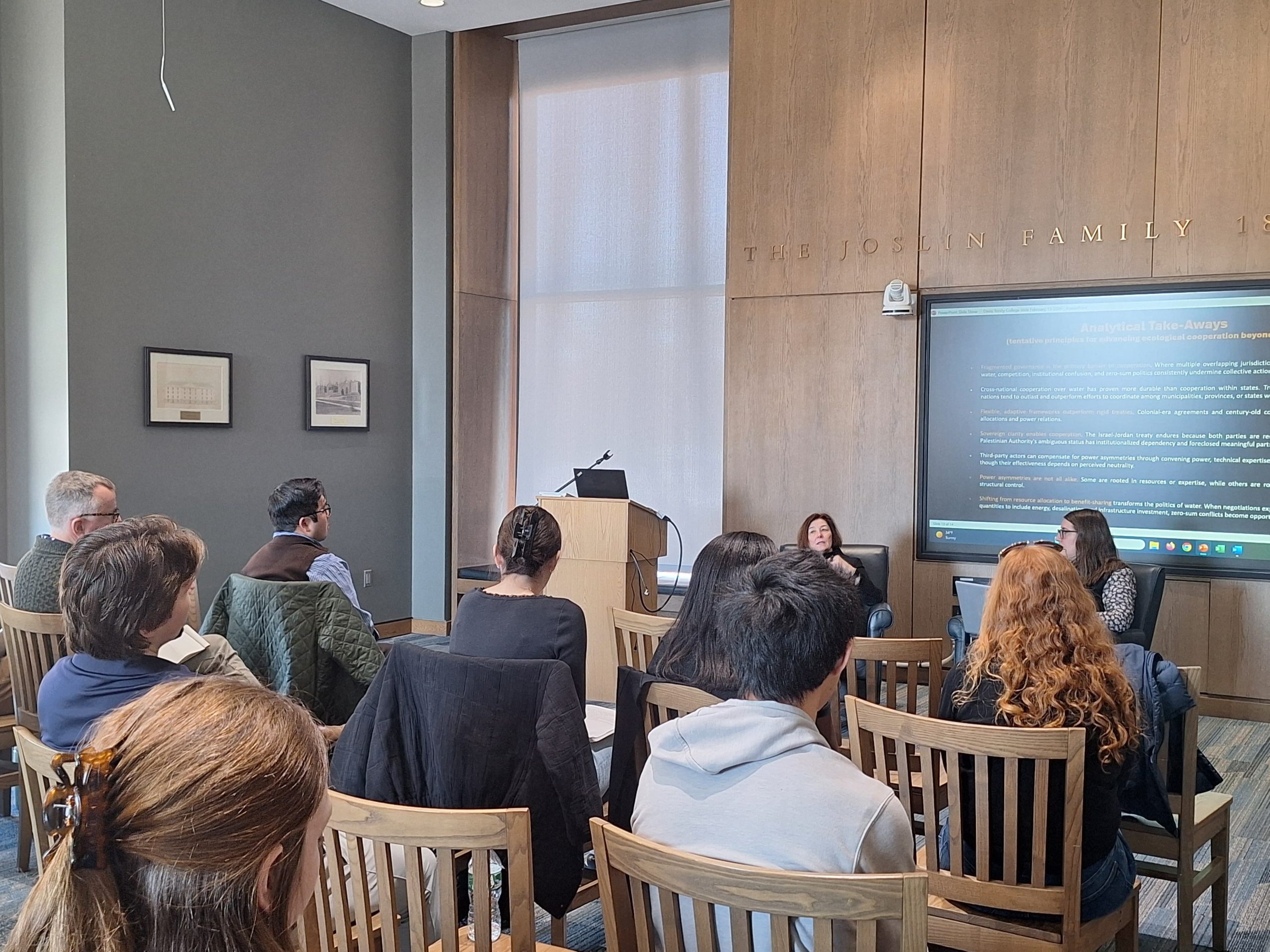
At 12:15 p.m. on Feb. 13, the Centre for Urban and Global Studies hosted a panel titled “Future Flourishing through Ecological Cooperation? Crossboundary Water Agreements in India-Pakistan, US-Mexico, Israel-Jordan,” at the Raether Library and Information Technology Center. The panel featured Professor Diane E. Davis, who serves as the Charles Dyer Norton Professor of Regional Planning and Urbanism at Harvard’s Graduate School of Design (GSD). The event drew over 30 attendees, including students and faculty members, as discussions arose over how water governance operates across national borders, even in regions marred by political conflict.
Professor Davis presented ideas from her paper titled “Searching for Mutual Co-existence Beyond Borders Through an Embrace of the Non-human Commons” and compared the water-sharing agreements in geopolitically tense regions of India and Pakistan; the United States and Mexico; and Israel and Jordan. The crux of her paper revolves around the question of whether ecological independence, particularly around water, can foster cooperation even in areas where diplomatic dialogue often fails.
“Water is central to everything,” Davis said during the discussion. “You can talk about energy too…without water, you cannot exist.”
Throughout the panel, Davis drew a critical distinction between water and many other natural resources, highlighting the point that water flows. Unlike extractive resources that can be contained within a single jurisdiction, rivers and other bodies of water cross political boundaries, which then connect communities that are upstream and downstream.
“We may as humans draw a boundary around a jurisdiction,” she said, “but water doesn’t know that.”
Since water systems ignore political lines and borders, governments are often compelled to negotiate, even in contexts where the broader relations are hostile. Davis noted that in some cases, crossboundary water agreements and treaties have endured and proven to be surprisingly durable.
In the United States-Mexico border region,“we found there were more examples of cooperation,” she said; there exist longstanding binational institutions and agreements between the states that manage shared resources. She further highlighted that such cooperation can at times be reinforced due to regional economic integration and shared environmental risks.
In contrast, due to the history of military conflict and territorial disputes, negotiations between Pakistan and India are “a lot more complicated,” David noted. Nonetheless, water agreements in that region have persisted to some extent despite periods of heightened tension; this demonstrates what she described as the unique pressures that are generated by ecological necessity.
The Israel-Jordan case also offers another example of how cooperation can emerge even during political instability.
Further along in the discussion, Davis also challenged the conventional understanding of sovereignty. She argued that people often equate sovereignty solely with nation-states and centralized authority.
However, shared ecological management may allow for alternative forms of collective governance; this is especially applicable in border regions where communities are economically and environmentally interconnected. If communities view a territory as collectively shared, then cooperation can hold ground beyond formal national boundaries.
“If people agree that this is our territory and we are collectively interested in managing it ourselves,” Davis said, collaboration becomes possible.
The panel also took note of the relationship between water and energy. Ecological systems become intertwined with political economies when hydropower infrastructure, dams and electricity exchanges become leverage points in bilateral dialogue.
“You can’t extract water from one point unless you know what’s happening downstream,” Davis said, highlighting the interdependent nature of water systems.
The questions within the panel then shifted to the issue of scale, asking whether joint action is more effective at national, regional or municipal levels. As climate change envelops the globe and is intensifying droughts, floods and water scarcity, Davis postulated that shared governance of water resources will become increasingly urgent. Urbanization, population growth and shifting weather patterns are already placing new pressures on existing fragile systems. She maintained that water’s essential role in sustaining life creates powerful incentives to cooperate.
“The commons are for helping humans survive,” she said, “not just increasing your power.”
The event concluded with further discussion among students and faculty about how ecological cooperation might shape future diplomatic strategies. While Davis acknowledged that agreements can break down during moments of political crisis, her research suggests that water, precisely because it is indispensable, can open channels of negotiation even in the most contested regions.


+ There are no comments
Add yours