





Sajja Ranjit ‘29
News Editor
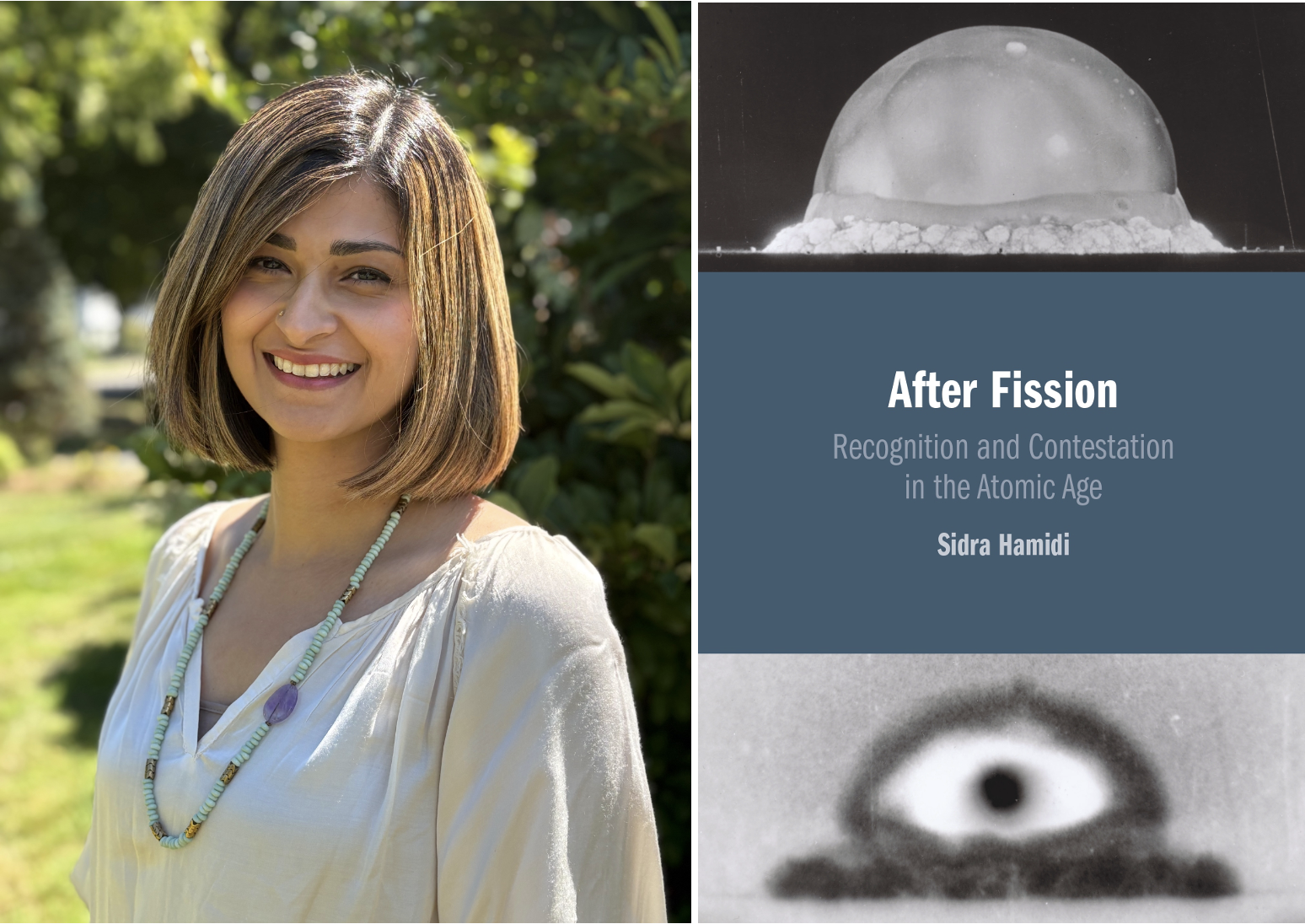
On Feb. 12, in the Joslin Family 1823 room in the Raether Library and Information Technology Center, a panel discussion was hosted on Professor Hamidi’s newly released book, “After Fission: Recognition and Contestation in the Atomic Age.” The panel brought together Professor of Political Science Andrew Flippert, student Diana-Maria Dinu ‘27 and Assistant Professor of Political Science Sidra Hamidi herself, to review and reflect on the book and its central arguments.
Professor Flippert opened the panel by highlighting key points in the book, such as how there is a critical social feature in nuclear relations as states are constantly performing to show their status in the world. He stressed the point that countries having nuclear technology is not equivalent to being a nuclear state. He added that states such as Israel and North Korea are very similar in terms of technology but are regarded very differently on a global scale. Flippert stressed that a state’s status, how it is perceived or recognized by others, can be just as important as its actual weapons or technology.
A major point emphasized throughout the talk, first highlighted by Professor Flippert, was the idea of “status anxiety” which refers to a state’s concern to how it is perceived, ranked and recognized within the international system, especially in the context regarding nuclear status. Rather than only focusing on whether or not a country has nuclear weapons, Hamidi argues that states care deeply about recognition as legitimate and powerful members of the global order.
In “After Fission,” Hamidi examines nuclear politics through the lens of social recognition rather than technical capability alone. The book argues that nuclear status is not a fixed fact, but something negotiated through international law, diplomacy, and global perception. Through case studies including India, Iran, Israel, and North Korea, Hamidi explores how states assert, claim, or are denied nuclear status and how global frameworks like the Treaty on the Non-Profilieration of Nuclear Weapons influence those dynamics.
Diana-Maria Dinu ‘27, who took Professor Hamidi’s course Global Nuclear Politics during Fall 2025, spoke about how much the experience impacted her understanding on international affairs. “I learned so much. I learned about so many regions of the world that I had never really thought about before,” she said. Reflecting on the book, she added: ”Reading about Asia and some of the theses I’ve seen in the book, I feel like she explains in such a knowledgeable and great way, it was definitely a great reading.”
Dinu began by highlighting the book’s case study on Israel, explaining how the country practices “nuclear opacity,” a strategy that allows Israel to keep its nuclear status officially undeclared. She noted that Israel has also never signed the Treaty on the Non-Proliferation of Nuclear Weapons, placing it outside of the formal international framework that regulates nuclear development and only recognizes five nuclear weapon states. According to Dinu, this deliberate ambiguity helps deter enemies while avoiding the full diplomatic consequences that often come with openly declaring nuclear capabilities. Dinu emphasized her belief that this approach creates a strategic advantage compared to other states such as Iran or North Korea, enabling Israel to maintain security leverage without formally inserting itself into the established nuclear hierarchies.
Dinu then turned to Iran, describing it and Israel as “mirror images” of one another in terms of nuclear politics. She emphasized that nuclear status is “also about how others perceive you, not just what you possess.” Dinu highlighted a point in the book noting that more Americans believe that Iran has nuclear weapons than Israel, despite the fact that Iran actually has no nuclear weapons while Israel is widely believed to have them.
Dinu also discussed North Korea, explaining how it “flips the dynamic” because it clearly has nuclear weapons and how the possession of these weapons today is directly tied to the survival of the regime and international recognition. She states how it’s interesting that even after about five tests of these nuclear weapons since 2006, the world still debates whether to accept North Korea’s status, highlighting how important and powerful status is. “It’s not just enough to have the bomb, you want others to acknowledge what that means as well,” Dinu said.
Finally, Professor Hamidi explained her motivation to write “After Fission,” stemming in part to her interest in specifically the case in Iran. “Since 2002, we’ve been hearing this same refrain of ‘Iran’s going to develop a nuclear weapon,’” Hamidi said. A central question of the book, she explained, is why these conversations arise every few years and why debates about Iran focus so heavily on what it might be capable of doing rather than what it has actually done.
Hamidi noted that she chose these four case studies, Iran, Israel, India, and North Korea, because they all interact in significant ways with the Treaty of Non-Proliferation of Nuclear Weapons. The treaty defines a nuclear-weapon state as one that tested a nuclear weapon before 1967, creating what she described as a technical standard with a built-in time limit. All four of these countries developed nuclear technology after that cutoff, placing them in ambiguous positions within the international system. Professor Hamidi suggests that this structure raises important questions about how international law shapes nuclear strategy and status.
During the question-and-answer portion of the event, the discussion briefly turned to the film “Oppenheimer” directed by Christopher Nolan. Hamidi noted that the bombings of Hiroshima and Nagasaki occurred just weeks after the successful nuclear test depicted in the film, highlighting how quickly scientific achievement translated into political action. Because nuclear weapons have only been used in war once, she suggested, they carry a certain mythic quality in global politics. She said the film effectively captures the tension between science and politics, particularly how scientists focused on building the bomb without fully confronting its consequences. The conversation also referenced Homi J. Bhabha, whose push for India’s nuclear development reflects the book’s broader argument that nuclear politics is shaped not only by technology, but by nationalism and international status.


+ There are no comments
Add yours