





Sajja Ranjit ’29
News Editor
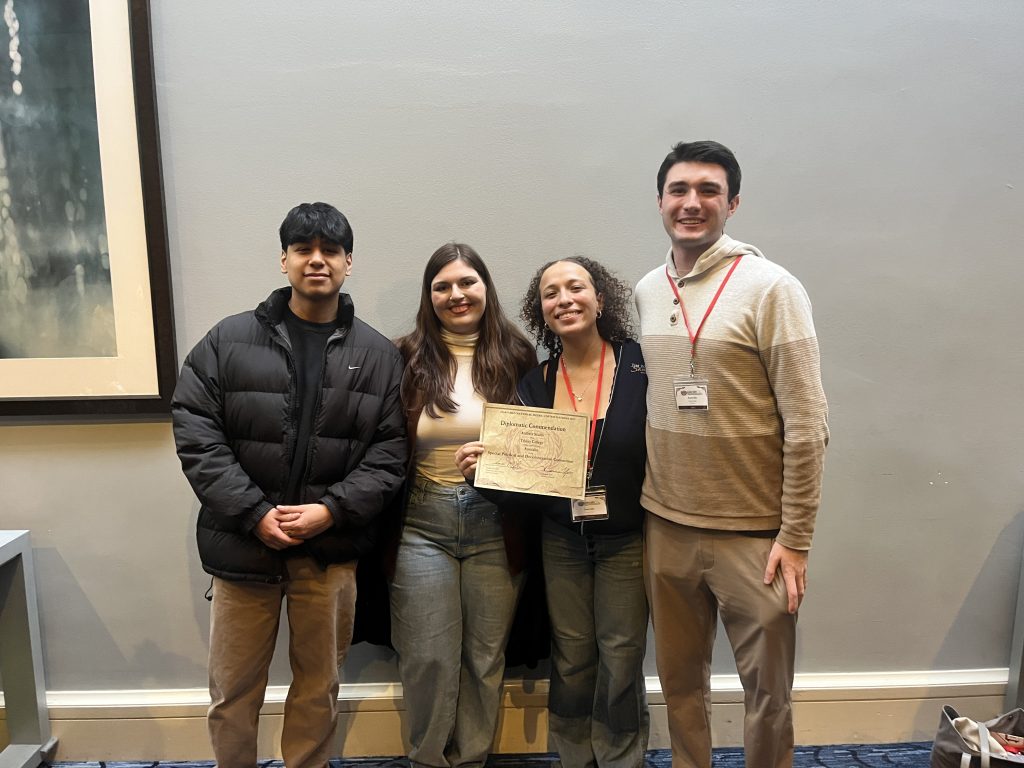
If you walk into Seabury N217 at 6 p.m. on a Tuesday, you might find students arguing policy as representatives of countries thousands of miles away. It’s not a political science class, but a weekly meeting of Trinity College’s Model United Nations team, where students practice diplomacy, public speaking and international relations.
Model United Nations, commonly named Model UN, is a simulation of the real United Nations where students represent different nations and debate various international issues in structured committees. Delegates research their assigned country, give speeches, negotiate with others and draft resolutions aimed at addressing global problems.
At Trinity College, the Model UN team consists of both a general club and a travel team that competes at conferences. The club is open to students of all majors and levels of experience, offering weekly meetings focused on discussions, skill building and preparation for conferences.
“I started Model UN in high school because I always really loved politics and wanted an outlet to do that,” Charlotte DeSimone ’27, co-president of the club told the Tripod. “It’s also a great way to form community and meet people.”
The club’s travel team represents Trinity at collegiate Model UN conferences, which bring together delegations from universities across the country and around the world. Students take on the role of diplomats, representing countries or historical figures while debating issues ranging from public health to international security.
“A conference is basically a bunch of colleges coming together,” DeSimone said. “You’re a delegate representing either a country, a person, or sometimes even a historical figure, and you work with others to write a resolution that solves the problem.”
These conferences often feature multiple committees focused on different global challenges. Delegates must collaborate with others to negotiate solutions and gather enough support for their proposed resolutions to pass, mirroring the processes used by the real United Nations.
Preparation for these events involves learning parliamentary procedure, researching assigned countries and developing public speaking skills. According to DeSimone, the club places a strong emphasis on helping students gain confidence in these areas.
“So much of our club is focused around public speaking skills,” DeSimone said. “It’s about learning how to present yourself in front of a room and work with others to solve problems.”
Part of what makes conferences engaging for DeSimone is the challenge of fully stepping into another country’s role. “You have to separate yourself from your own values and think about what your country would actually do,” she said. “I once represented Iraq on a committee about women’s reproductive health. It was challenging because I didn’t personally agree with some of the policies, but part of the role is negotiating and finding solutions within the framework of the country you represent.”
The team has also built a strong reputation within the NESCAC. According to DeSimone, Trinity’s Model UN program is currently ranked first among travelling teams from NESCAC schools based on conference performance and awards. “We’re competing among Ivy League schools where their acceptance rate for the club is like 10%,” DeSimone said. “It’s kind of a big-league environment, so you have to have the confidence to get up and speak and know that you deserve to be in that room.”
For many members, the club also offers opportunities to travel and compete at prestigious conferences. In Feb. of 2025, Trinity students attended Harvard Model United Nations, one of the largest and most competitive collegiate conferences in the world. Despite having only a small delegation and limited preparation time, the team found success at the conference. One Trinity delegate, Andreia Soares ‘27 earned an award for Diplomatic Commendation, an experience Simone described as particularly meaningful: “As a mentor and leader, it was really rewarding to see someone gain the confidence to win an award in a room full of people who win awards constantly,” DeSimone told the Tripod.
The club’s leadership also emphasizes the broader skills students gain through participation. Max Ryan ‘28, co-president of the team, said Model UN helps members build confidence and develop leadership abilities that extend beyond international relations: “You kind of can’t hesitate when you’re up there speaking,” Ryan said. “You have to trust that you’ve practiced and just let it flow.”
In addition to the academic and professional benefits, members say the sense of community within the club is one of its biggest draws. Through weekly meetings, travel, and shared preparation for conferences, students often form unlikely but close friendships. “We’re just a bunch of friends that love what we do,” DeSimone said. “It’s a really welcoming community.” “We act more as a friend group than a club,” Ryan added. “We all know each other and take these trips together, and you get so close. It’s a lot of fun. There are some challenges here and there, but it’s always worth it. We work through it.”
Looking ahead, the team hopes to continue growing its membership and bringing more students to conferences. The club is currently planning to attend a conference hosted by New York University and hopes to bring its largest delegation yet.
For students unsure about joining, Ryan encourages them to attend a meeting and see what the club is about. “You really do meet people you wouldn’t expect,” Ryan said. “We kind of act more like a friend group than a club.”
At its core, Trinity’s Model UN gives students the chance to think globally, speak boldly and find a community of peers who push them to do their best.
+ There are no comments
Add yours