





Donald Bishop ’67
Alumni Contributor
The publication of “A Fate Worse Than Hell: American Prisoners of the Civil War” by W. Fitzhugh Brundage of the University of North Carolina sheds new light on the Union and Confederate camps for those taken and held as prisoners of war (POWs). Drew Gilpin Faust’s recent review of the book noted “three times as many Union soldiers died at the Confederate camp in Andersonville, Georgia, as at Gettysburg.” In the Union prison camp at Elmira, New York, dubbed “Hellmira” by the southern POWs, almost three thousand died during the single year it operated.
During the Civil War, 71 Trinity men served in the Union Army, Navy, and Marine Corps, while 27 served in the Confederate forces. Four alumni, all in the Union Army, endured imprisonment.
Franklin Hayes ’65: Hayes left Trinity to enlist as a private in the 16th Connecticut Volunteer Infantry Regiment, and he was among its 779 raw troops thrown into the Battle of Antietam only three weeks after their first muster. Many had never before fired their rifles. During the two-day battle the unit lost 43 who were killed, 161 wounded and 204 captured or missing.
The tattered regiment was then sent to the Virginia and North Carolina coasts. On April 20, 1864, at Plymouth, Virginia, about 2800 Union soldiers were “outnumbered 5 to 1 with no hope of escape or reinforcement.” After three days, the Union garrison surrendered, and the 16th Connecticut’s soldiers became prisoners. The POWs were sent to the infamous Confederate prison camp at Andersonville, Georgia. When they reached the camp, many were “walking skeletons.”
There were up to 33,000 Union POWs in a camp that covered 26.5 acres. The Trinity campus from Vernon Street to New Britain Avenue covers roughly 100 acres, so stand near Bishop Brownell’s statue and imagine 33,000 men on about one-fourth of the campus.There were no barracks or tents. The prisoners scraped together whatever shelter they could — lean-tos, small caves, holes, dugouts, small shanties, and “shebangs” made from sticks, blankets, tent flys, and scrap wood.
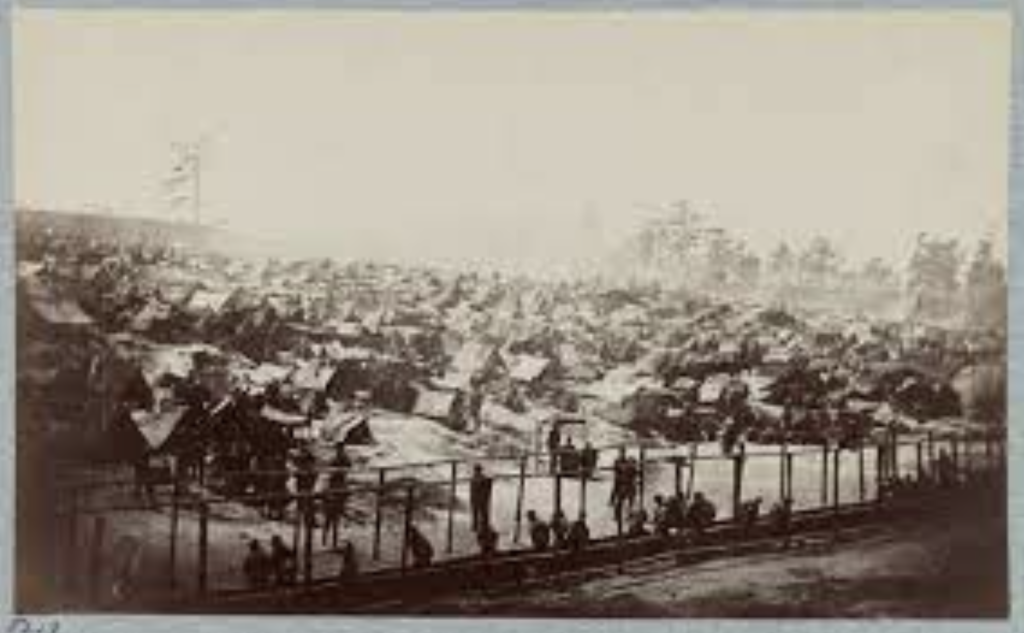
One small creek, Stockade Branch, its waters already contaminated upstream, provided the only water. The National Park Service records that 13,000 Union soldiers died from disease, poor sanitation, malnutrition, overcrowding, or exposure. A hundred of the 16th Connecticut’s soldiers died there, Hayes on Sept. 20, 1864.
In 1907, Hartford dedicated a memorial — Bella Lyon Pratt’s “Andersonville Boy” — to honor the many Connecticut soldiers who died in the infamous prison camp.
William Henry Noble ’32: Noble attended the new Washington College for two years before graduating from Yale. He practiced law, and in the 1840s he became the county clerk of Fairfield County and state’s attorney. When the war began, he was practicing law, and although he was a Democrat he believed the union must be preserved.
He was commissioned as colonel commanding the 17th Connecticut Volunteer Infantry Regiment. At Chancellorsville his horse was killed and he was wounded and hospitalized. Hearing that the Union and Confederate armies were to clash in Pennsylvania, he left his sick bed and reached Gettysburg on the third day of the battle.
He later commanded a brigade in Florida. Captured by Confederate Scouts on Christmas Day, 1864, he was sent to Andersonville. As the highest-ranking Union officer confined there, he received better treatment than most. He was there only a few months, but Historian Mary Witkowski related that “Noble would often remember the horrors of that ‘snakepit’ with a shudder and a curse.” In March, 1865, he was paroled and reported at Vicksburg. In later years, friends noticed he could not speak of the camp without agitation. He was promoted to Brevet Brigadier General of Volunteers before the war ended.
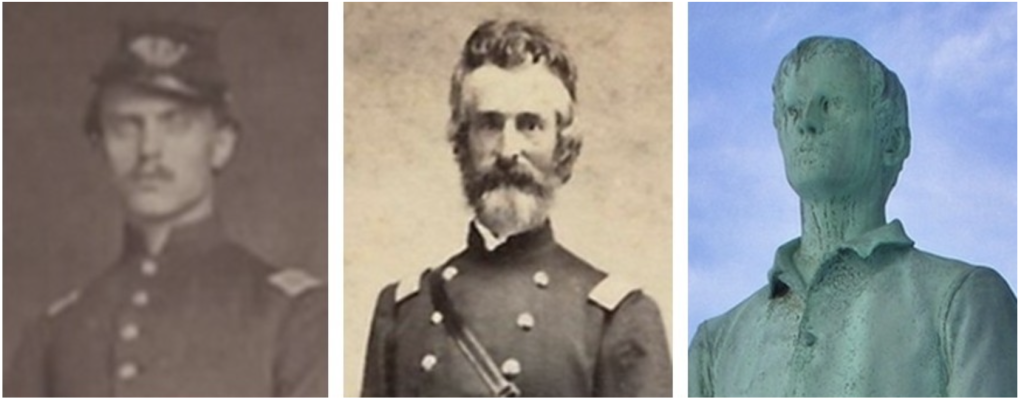
Photo Credit: Moorestown Historical Society
George Washington Hugg ’62: Hugg, who came to Trinity from Moorestown, NJ, was salutatorian of his class. He and a classmate, Daniel Perkins Dewey, both joined the25th Connecticut Volunteer Infantry Regiment. At the Battle of Irish Bend, Louisiana, in June 1863, the Confederates attacked their Company A positioned on the flank of the Union line. The company commander was killed; Dewey led an organized withdrawal but suffered a head wound and died; Hugg, next in line to command the company, was captured. He was imprisoned in the largest Confederate POW camp west of the Mississippi, at Camp Ford, Texas. A summary notes that its stockade of 10 to 16 acres then held about 4000 Union prisoners. They had to construct their own shelters; many were “log shanties.” Beef, cornmeal, bacon, and baked beans were the usual provisions, but they became less available as the war continued.
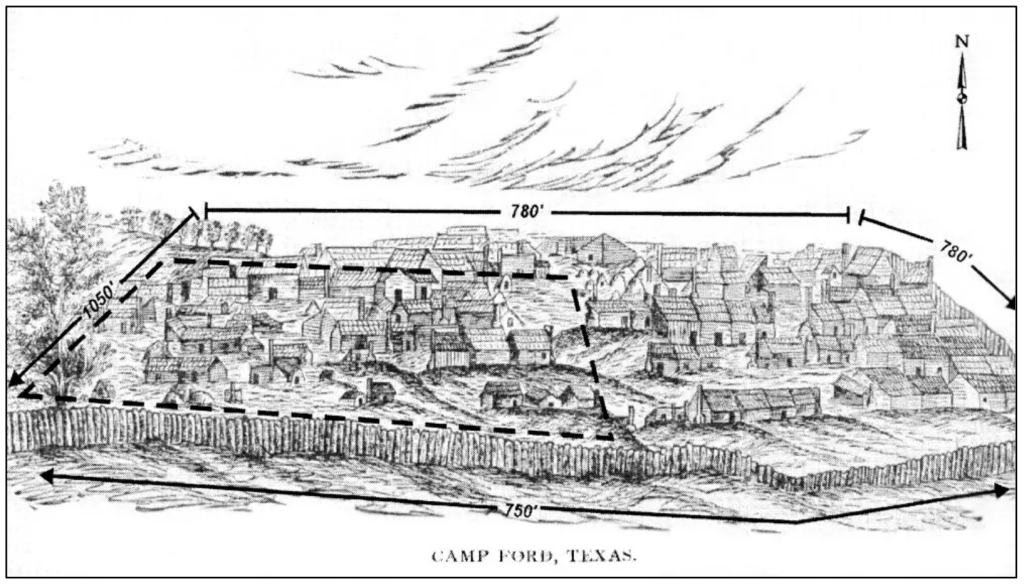
Hugg was held for a year in the prison camp. Exchanged due to ill health in July, 1864, he wrote his parents from New Orleans that he had “reached a Christian land,” free. Since there were Christian churches all over the south, as in the north, Hugg’s letter implies that conditions in the prison camp had led him to conclude the Confederacy and had forfeited its Christian character. Hugg died in a hospital a week later.
John Flavel Mines ’54: After Trinity and divinity school, Mines was ordained in the Episcopal Church and initially served at a church in Broad Brook, Connecticut. In 1861, he was rector of Grace Church in Bath, Maine, and the chaplain of a local militia unit, the “Bath Grays.” At his church on Jan. 4, 1861, “the national day of fast” proclaimed by President Buchanan to avoid war, he preached on “Duty, our highest right.”After the war began, apparently urged by his bishop, he volunteered for active service and became chaplain of the three-month 2nd Maine Volunteer Infantry Regiment.
Rushed to defend Washington, the unit moved into northern Virginia in July 1861. In the Battle of Bull Run, it lost 47 soldiers killed or wounded, the regiment’s color sergeant dying in Mines’ arms. He “soothed the last hours of Major Ballou” — whose final letter to his wife still inspires new American generations. When the regiment retreated, 25 wounded soldiers could not be moved, and Chaplain Mines remained with them. When he was taken prisoner, Mines expressed “a strongly detrimental attitude toward the war” that offended the senior southern officer, who ordered that Mines not be exchanged or paroled (as was the usual case for chaplains). Mines became one of about 700 Union officers held in the infamous Libby Prison in Richmond. Its main building was an overcrowded three-story former tobacco warehouse with no individual cells or rooms. The POWs slept in tight rows on bare floors. According to the National Park Service, the prison had “cramped quarters, poor sanitation, outbreaks of disease, and extreme temperatures during winter and summer months.”
Mines was held at Libby Prison in the first year of the war before conditions there became deadly. The Encyclopedia Virginia describes “severe food shortages,” lack of “furniture, blankets, and eating implements,” lice, and “wasting away of body and mind.” Rats roamed the premises. Chaplain Mines – described as “genial, bonhomme” — prayed with and consoled many Libby POWs as they died. He was separated from his family, and he feared consumption. He made many petitions to the Confederate Secretary of War asking for parole, going so far as to state “I have acknowledged . . . the independence of the Southern Confederacy” and “I have always been a pro-slavery man and a Democrat of the Southern school.” He was exchanged in June 1862 and resigned from the Army. In 1865 he left the ministry too. Near the end of the war he received a commission as a lieutenant colonel in the 1st District of Columbia Cavalry (many of its companies were recruited in Maine). After the war he was a journalist (often using the pen name “Felix Oldboy”) and author. He died of alcoholism in 1891.
The Trinity men who joined the U.S. Army during the Civil War were variously motivated — some to topple slavery, others to preserve the union, some to join friends and classmates in local regiments. The endured training, marches, movement into the South, river crossings, rain and mud, malaria and other illnesses, battles and wounds. Twelve gave their lives — two due to the unique hardships of imprisonment. When you pass by the “Andersonville Boy” statue on the west side of the Connecticut State Capitol, not far from the original Trinity campus where they had studied, remember them.



My wife’s Great-Great Grandfather, James Mackrel (also spelled Mackeral in some reports) died in Andersonville, not sure where he was captured or his date of death. We visited the Andersonville site Memorial Day 2025 and saw his grave. Very disturbing to think humans could treat other humans, let alone fellow countrymen, like that.