





Sajja Ranjit ‘29
News Editor
A panel of Trinity Faculty and senior Anna Sznesnat ’26, a public policy major in the process of writing her thesis, gathered in the Joslin Family 1823 Room to explore the complex intersections of religion, land and law. The event featured Assistant Professor of Religious Studies Samuel P. Catlin, Professor of the Practice in Public Policy & Law Glenn W. Falk and Associate Professor of Religious Studies Mareike Koertner.
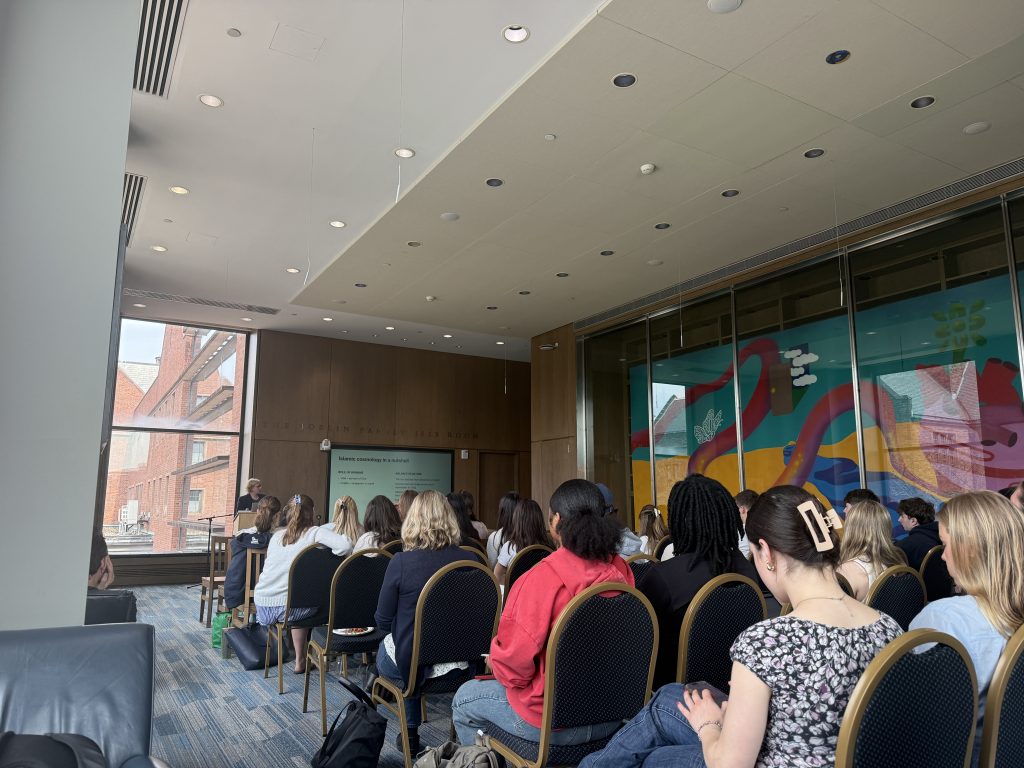
Professor Falk opened the event with a land acknowledgement recognizing that Trinity College sits on unceded indigenous land and honored the indigenous communities who have lived in and around the Connecticut River Valley for generations.
Professor Koertner began the panel by examining how religious traditions shape environmental thought, introducing the concept of “ecological theology.” She highlighted the work of Islamic scholar Seyyed Hossein Nasr, who argued that modern environmental crises stem from secularism and materialism. “People have started to think about the natural world as something that can be exploited at their own will,” Koertner explained.
Drawing on Islamic teachings, she described how humans are understood as servants of God (“abd”) and stewards (“khalifa”) of the Earth, responsible for maintaining the natural balance created by God. This framework, she noted, has been widely used in environmental activism and education and is largely uncontested within Islamic theology.
Koertner then contrasted this with Christian perspectives referencing historian Lynn White Jr., who argued that Christianity contributed to environmental degradation by emphasizing human dominance over nature.
White controversially claimed that Christianity contributed to environmental degradation by promoting human dominance over nature, drawing on biblical passages such as Genesis 1:26 which states: “Then God said, ‘Let us make mankind in our image, in our likeness, so that they may rule over the fish in the sea and the birds in the sky, over the livestock and all the wild animals, and over all the creatures that move along the ground.” as Koertner states, “not as our own, but as custodians.” Others, however, have interpreted scripture as supporting the exploitation of natural resources, a view that has been amplified by corporate interests.
“Taking care of our common home is a moral responsibility,” Koerner said, noting that Pope Francis also links environmental degradation to broader issues of social inequality.
Professor Catlin followed by shifting the conversation to Judaism, focusing on how religious law and ethics shape understandings of land: “Law in Judaism is not just law in the civil sense, it is a way of life,” he explained, describing halakha as a system that governs all aspects of human behavior. Referencing passages from Leviticus, Catlin emphasized that religious law extends beyond actions to include ethical obligations. “You shall love your neighbor as yourself,” he said.
Catlin argued that these commandments challenge conventional ideas of identity and belonging: “The neighbor is not someone who is like you, it may be someone with whom you have nothing in common,” he said. Catlin connected these ideas to the historical experience of the Jewish diaspora and warned against exclusionary claims to land, pointing to the territorial ideology of Nazi Germany as an example of what happens when a group tries to define who belongs and who doesn’t.
The panel concluded with a presentation by Anna Szesnat ‘26, whose research examines how U.S. law defines religion and its limitations in protecting land-based spiritual practices. “Religion, in American law, is understood as something internal. Something you carry with you,” she said.
Focusing on the Western Apache community in Arizona, Szesnat analyzed the ongoing legal case surrounding Oak Flat, a sacred indigenous site on government land slated for copper mining after its mining rights were sold to Resolution Copper as a rider in the 2015 National Defense Authorization Act.
“But what happens when religion is not structured around belief, but around place?” she asked. For the Western Apache, Oak Flat “itself is sacred. It is not interchangeable and cannot be replaced,” Szesnat explained. She described the Sunrise Ceremony, a coming-of-age ritual for girls, which must take place at Oak Flat using materials gathered directly from the land: “The ceremony cannot be moved without fundamentally changing what it means to be Apache.” According to Szesnat, the proposed mining site would permanently destroy the site, making the ceremony impossible to perform. Despite this, courts have ruled that no violation of religious freedom has occurred, since individuals remain free to hold their beliefs.
“The issue is not belief. The issue is whether the ceremony can even take place,” she emphasized. Szesnat also noted the broader impact of the decision. “The harm is not just to individuals. It’s to the entire community and the continuation of the religion itself,” she said.
As debates over environmental policy and Indigenous rights continue, the panel made clear that religious and legal frameworks play a crucial role in shaping how those conflicts unfold.
+ There are no comments
Add yours