





Sajja Ranjit ‘29
News Editor
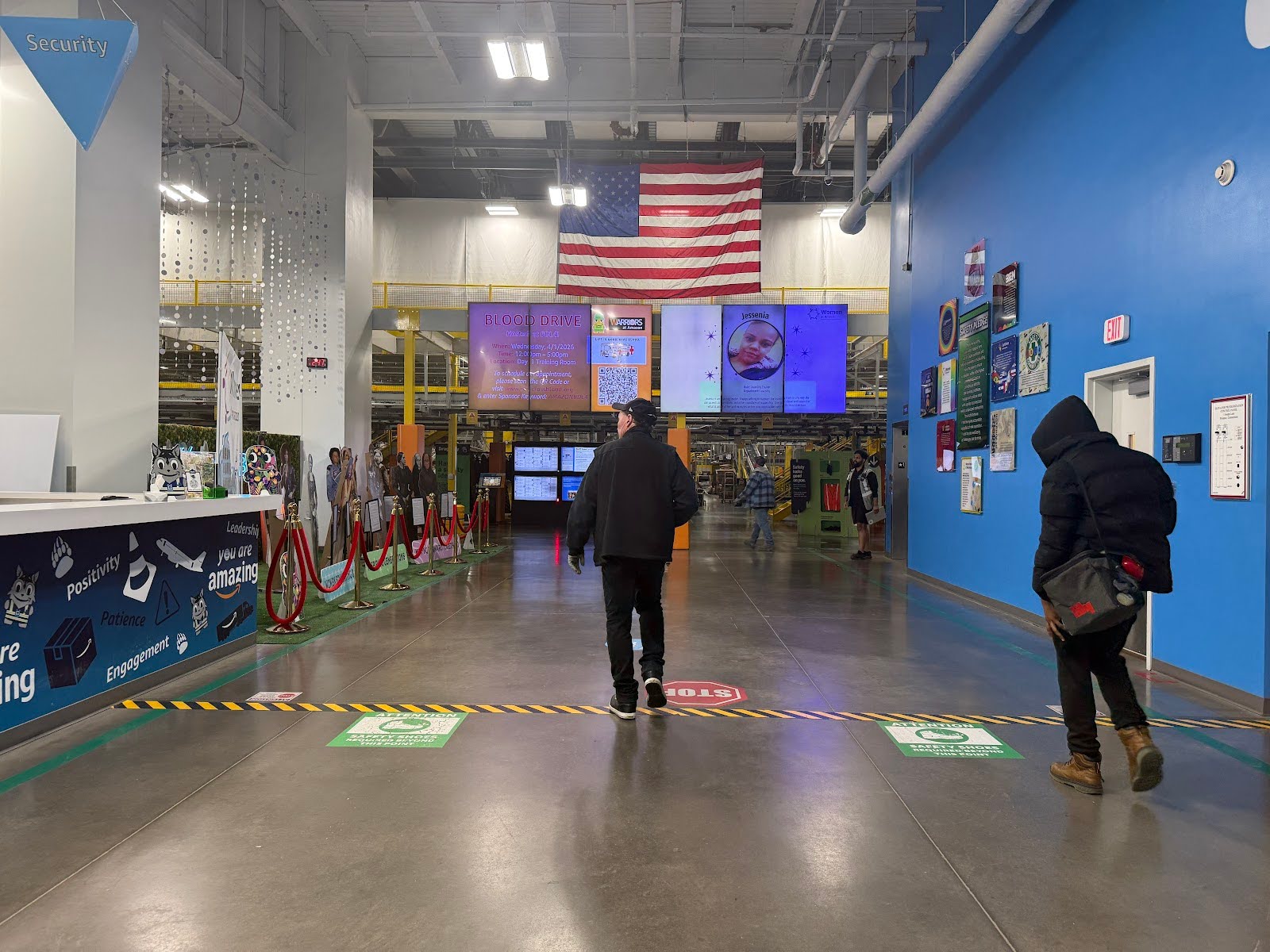
Trinity College students recently got an exclusive look inside one of Amazon’s Connecticut fulfillment centers in Windsor. Guided by Paul Collins III, who manages daily operations, and Wyatt Bosworth, a state public policy expert on AI and technology, students were able to see how Amazon utilizes AI and robotics on a daily basis.
The visit was organized through the Elting Center for Entrepreneurship and Innovation and accompanied by Kenneth A. Kousen, Visiting Professor in Computer Science; Danny Briere, Ruane Family Executive Director of the Elting Center; Maria Dyan, Associate Director of Strategy and Student Development; and Entrepreneur in Residence Reid Lewis.
While the Windsor site is open to the public for tours, Briere told students it took him around three years of coordination to arrange this in-depth visit for Trinity students. Unlike standard tours, this experience took students deeper into the facility, showing operations and technology not normally visible to the public.
The tour offered a view of the 3 million square foot, four floor facility which employed roughly around 4,600 people, and handles same day delivery, the only center in Connecticut to do so. Collins explained that the building, classified as a Gen 11 facility, uses densification strategies powered by AI to add storage fields and maximize efficiency.
This facility specializes in packages weighing up to 25 pounds while other Amazon centers focus on heavier items. Retrofits like Proteus drives, which are moving carts that associates can interact with, and robotic arms supplement operations, while Kiva robots deliver items directly to employees for packing.
“Most of the designs here are made to bring work to people,” Collins said, emphasizing how automation has reduced the physical strain on workers. “People don’t have to walk 12 to 15 miles a day. They now come to them.”
When asked about robot malfunctions, Collins mentioned dust on the floors can disrupt operations. “Dust is a big thing because there’s QR codes on the floor that Kiva robots use, so issues with that occur a lot.” Collins said.
Attendees were struck by the scale, but moreover, the simplicity of the systems: “It seemed a lot more simplistic than I thought, taking items off the truck, storing them, and then picking them, but elegant in its simplicity. Multiplying that process by thousands of items makes it impressive” Kousen remarked.
Kousen also observed the distinctive movement of the robots: “They move in a jerky motion, then stop, twist, and move another way. It was fascinating to watch.”
Bosworth explained the role of AI in the facility’s operations: “We have an entire team that does predictive stocking, not just here but across the nation,” he said. Seasonal trends, such as increased demand for flip-flops in the summer, are analyzed and incorporated into the system. Different departments use specialized AI, all while services are developed by Amazon Web Services (AWS) and business partners.
Collins also addressed concerns about automation replacing human labor. “No, I don’t expect any decline in employment here. All the technology is made to get jobs to people,” he said.
While robotics streamline repetitive or physically demanding tasks, human workers remain essential for quality control. Many improvements, from optimizing robot routes to predictive stocking, stem from the suggestions of associates who spend hours interacting with the system.
The center’s use of AI extends beyond logistics. Augmented reality helps guide processes, and advanced analytics monitor performance across departments. Collins noted that new technologies, including drones for potential delivery in Connecticut, are being explored. Future Amazon centers will incorporate new building types, such as Gen 12 and Gen 14 structures, which, compared to the current Gen 11 facilities, feature increasingly advanced robotics, higher storage density, and allot different tasks to associates, while Gen 13 is skipped due to superstition.
Students also observed innovations like Proteus drives and robotic arms. Collins emphasized that while robotics improve efficiency, the human element remains vital: “As tech changes we will always go and change things.” Collins stated.
+ There are no comments
Add yours