





Cam Guendner ’30
Contributing Writer
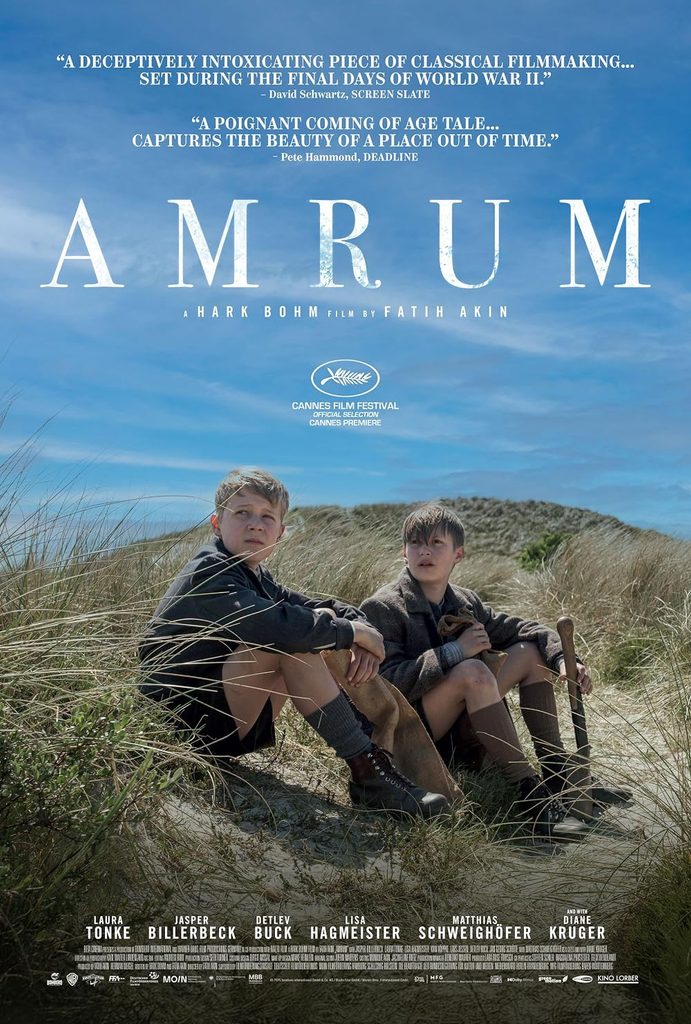
“Amrum,” the 2025 war drama from famed filmmaker Fatih Akin is, to borrow from the film’s own language, “ein Meisterwerk”— a masterpiece.
The film, based on the childhood memories of Hark Bohm, a German screenwriter, follows a twelve-year-old German boy, Nanning Bohm, played by Jasper Billerbeck, during the final months of World War II. After Hamburg is bombed by the Allies, Nanning, his two younger siblings, aunt and pregnant mother move to the isolated island of Amrum in Northern Germany. Nanning spends his days farming potatoes and fishing to support his family, as well as taking part in the National Socialist youth program by the wish of his mother. As the war comes to an end and Nazi Germany’s defeat is imminent, Nanning’s mother, a supporter of the Third Reich, is emotionally paralyzed by the collapse of the regime. In hopes that he will liberate his mother from this depressive state, Nanning scours his depleted and austere town to find his mother’s favorite meal, honey and butter on white bread.
The overarching thematic question that the film dives into is the idea of individual conscience versus collective/inherited beliefs. Although Nanning is born into a fascist household, he is completely unaware of the atrocities associated with his family’s political affiliations and consistently proves that he himself is not full of hate but instead, only indoctrinated into the cause. I personally found the film’s simplistic story-telling more thought provoking than other more action-driven WWII media such as “Saving Private Ryan” or “All Quiet on the Western Front.” The film did not dig deep into the trenches of the frontlines, it instead examined the effects of strong political influence as well as the preservation of human morality through the perspective of a young boy.
Throughout the film, Nanning displays everlasting persistence to hunt down the ingredients that will serve his mother’s hunger. This relentless pursuit speaks to the idea of innocence and guilelessness children possess. Although there may be barriers to feeling sympathy for Nanning due to his family’s status, his personal pure and kindhearted actions brought to my mind the idea of humans being inherently good, yet subconsciously corrupted by their environment. In my interpretation, the purpose of the film was not to garner sympathy for the Axis powers or to rationalize their ideology, but rather to convey the damaging effects of indoctrination and highlight how easily conscience can be silenced by loyalty, shared beliefs, and inheritance.
The film’s multi-layered plot and captivating yet contentious concept can be wholly credited to the co-producers of the film, Fatih Akin, Herman Weidgel, Lara Förtsch and Ann-Kristin Bardi as well as its script’s co-authors Fatih Akin and Hark Bohm. “Amrum” was initially conceived and had planned to be directed by Bohm himself, as it was derived from his experiences as a child; however, as his health declined he asked former student, Fatih Akin, to take over the directing duties. Akin initially had reservations about taking over the project as he felt that he was not close enough with the screenplay, yet after spending time with the material he was able to grow a personal connection to the film and direct it in Bohm’s honor. Before his passing in 2025, Bohm shot a brief cameo that can be seen near the end of the film, giving the famed director, screenwriter, actor, and mentor one last time in the spotlight.
As to the cinematic elements of the film, I was pleasantly surprised at the visual execution. With the majority of shots being filmed on the island of Amrum itself, Karl Walter Lindenlaub’s cinematographic style displayed the vast shorelines and beautiful windswept plains of the isle perfectly. It felt as if I was alongside Nanning on his quests, only with the addition of subtitles. Yes, this film is entirely in German, but that did not deter me from walking into Cinestudio with my elementary knowledge of the language and walking out saying: “acht von zehn” — (8/10).