Carlos Fonseca ‘30
Contributing Writer
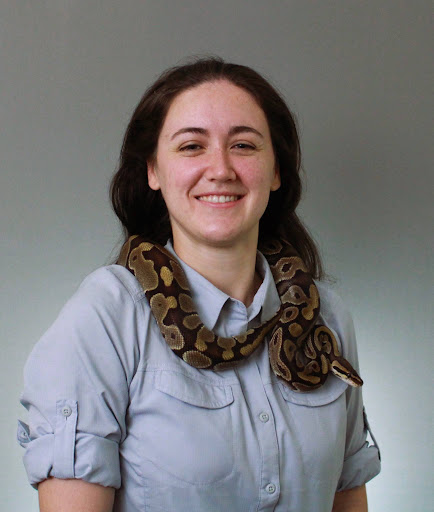
Last year, Trinity welcomed Professor Rachel Keeffe to the Biology Department. An evolutionary biologist with a lifelong fascination for reptiles and amphibians, Keeffe brings a unique combination of research, teaching and, most noticeably, animals to campus.
Keeffe’s interest in animals began when she was only six years old. “I remember seeing a frog for the first time and I was in love,” Keeffe told the Tripod. “I loved it immediately, and I needed to know everything about them.” As a child, Keeffe initially thought that a career working with animals meant becoming a veterinarian. Eventually, however, she discovered herpetology, the study of reptiles and amphibians. “The minute I knew that was a job, I knew that needed to be my job,” Keeffe said.
Keeffe went on to study biology at UMass Amherst, where her time as an undergraduate introduced her to the world of scientific research. She later earned her Ph.D. in Zoology from the University of Florida, where she studied the functional morphology and biomechanics of frogs, before completing a three-year postdoctoral fellowship at Mount Holyoke College.
Now at Trinity, Keeffe works as an evolutionary biologist, using comparative anatomy to explore the diversity of animals and understand why different anatomical structures have evolved. “Mostly it just involves studying why things are shaped the way they are and how that relates to how they work,” she explained. Her current work includes research on the reproductive anatomy of snakes and lizards. Keeffe explained that although scientists have long documented differences in male reproductive anatomy, researchers historically paid less attention to why these differences existed and how they related to female anatomy. “It’s really hard to understand why the genitalia of one sex looks a certain way … without looking at the other,” she said.
Her research has also involved CT scanning specimens and producing enlarged 3D-printed models to better understand how anatomical structures function. It is the unanswered questions surrounding these structures that continue to drive her research. “This fascinates me as someone who is interested in biomechanics,” Keeffe said. “And so, this keeps me up at night.”
That enthusiasm carries directly into Keeffe’s teaching at Trinity. As one of the professors teaching BIOL-182, Trinity’s introductory biology course, she teaches students about animals and tries to bring different live species into class whenever possible. “Each class I try to bring in a different species of live animal,” Keeffe said, “because I know that that’s what drew me into the field.”
I was able to meet one of those animals during our conversation: a vinegaroon, an arachnid related to scorpions. Keeffe explained that exposing students to animals they may never have encountered before is more than just making class interesting. She hopes one of those encounters might ignite a passion similar to the one she experienced when she first saw a frog as a child. “If it makes someone learn that they actually love arachnids, then that would be awesome,” she said. “Because I don’t have enough time in my life to also study vinegaroons, but maybe one of you would be excited enough to go and pursue that.”
That invitation extends beyond the students in her classes. Keeffe encourages anyone interested in her work, or simply curious about the animals she keeps, to come by and talk. “If the door is open, then I’m happy to show you some of the creatures,” she said. For Keeffe, providing these opportunities is important. “I think it’s important for people to have that opportunity because it was so important for me as a kid,” she said.
Keeffe explained that when she was younger, she did not realize just how many different careers could grow out of an interest in animals and biology.
“If I could talk to myself when I was your age, I would say there’s so many different things to do, so just ask questions and learn,” Keeffe said.
Since joining Trinity, Professor Keeffe has brought her research experience and enthusiasm for biology into both the department and the classroom. After speaking with her, what stood out most to me was how much of the curiosity she had as a child still carries into her work today. The fascination that started with a frog now shapes both her research and the way she teaches.
So, whether you are a biology student, an aspiring scientist or simply someone who wants to meet a snake, lizard or vinegaroon, consider stopping by Professor Keeffe’s office. If the door is open, you may get the chance to meet a few of her creatures and have an amazing conversation along the way.