





Alex Gervais ’28
Managing Editor
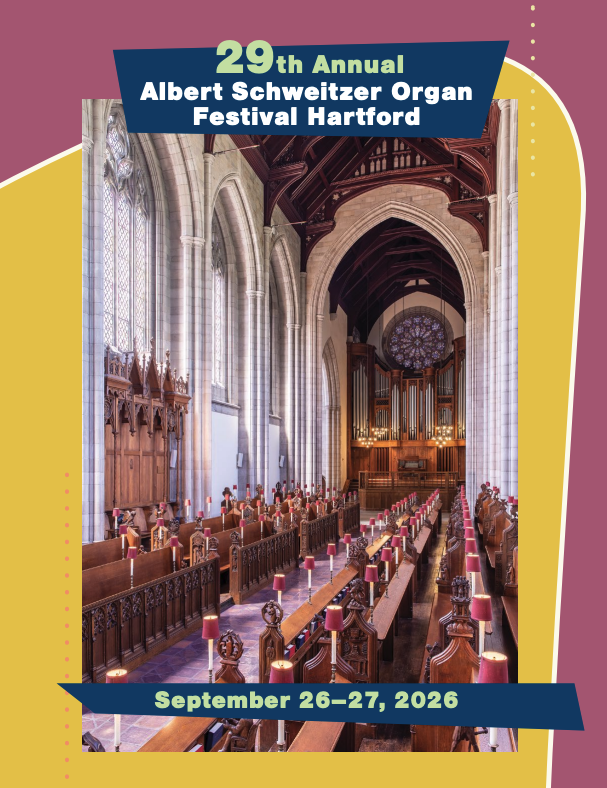
On Saturday, Sept. 26, I attended the 29th Annual Albert Schweitzer Organ Festival Hartford. As someone whose organ experience extended only to going to Midnight Organ on Halloween last year and “Take Me Out to the Ball Game” at Fenway (shoutout to the incredible Sox organist Josh Kantor), I had no idea what to expect for the night. Would I sit in a half-empty chapel listening to a 20-minute piece of choral music that had seemingly dragged on into its eighth movement, or would I experience something truly special?
I’m happy to say it was the latter. The Organ Festival is one of those events that only comes around once-in-a-Trinity. This year was the 29th time the festival has run, and was the 10th anniversary of it here at Trinity after it transitioned out of its previous home at a Wethersfield church. As Carolyn Kuan, music director for the Hartford Symphony Orchestra (HSO) put it in the pre-concert panel: “it was time for the festival to go to college.”
The primetime performance was billed as “Music in a Gothic Space,” an accurate description of the night’s event. The true star of the show was the organ, expertly played for much of the show by none other than Trinity’s own John Rose Distinguished College Organist, Director of Chapel Music and Artist-in-Residence, Christopher Houlihan ’09. The Hartford Symphony Orchestra, directed by Carolyn Kuan, was the perfect foil for Houlihan’s commanding organ. The two worked in symbiotic harmony, almost mirroring a call-and-response during parts of the program.
Music played on the organ is the type of music that, ironically, has to be seen to be believed. It’s music worst listened to alone in your bedroom on a pair of three-year old Airpod Pros. It’s music best listened to in the Chapel sitting on a pew built in 1935. The grandness of the organ itself makes it a commanding musical storyteller. It both dominates and underscores, leading the show but assisting seemingly every other instrument.
The program they played consisted of pieces by Horatio Parker and Steven Sondheim, seminal composers in American classical music. They also played a piece by Samuel Barber, where the organist performs a cadenza pedal solo. Their rendition of Sondheim’s “Everybody Says Don’t” from “Anyone Can Whistle,” was particularly impressive, bringing the most raucous cheers of the night as the program approached intermission.
Following intermission, the winner of the Festival’s Biennial Young Professional Competition, Nathan Ringkamp, played a piece by Rachel Lauren unaccompanied by the HSO. The HSO followed his performance by playing a couple of pieces by Barber without accompaniment from the organ. Both of these performances, while absolutely performed technically well, felt emptier without their respective counterparts. It felt that the solo organist was missing the pep and rhythm brought by the orchestra, and the orchestra was missing the grand, menacing sound of the organ.
The crowd reacted to this schism accordingly: the same people who seemed to hang on to every note of Houlihan and the symphony’s earlier performance began to seem distracted, their eyes cast not towards the band but instead gazing up around the Chapel or down at their phones. For those still iron-focused on the orchestra it seemed like a different kind of attention, a forced, polite attention; not the gripping excitement Houlihan’s organ had inspired in the crowd.
But then, Houlihan returned. As he strided back up to the organ for what he earlier referred to as a “planned encore” the Chapel became abuzz with the excitement of organ yet again. As he set up his sheet music the crowd whispered in anticipation, they sat up a little bit straighter, as if they already understood what was coming next.
During the pre-show panel he delivered the quote that became the title of this piece: “I love when music makes us chuckle a little.” A chuckle is an apt description for the night. While even in Trinity’s oh-so-grand chapel playing swelling, emotional music, the symphony still had fun. At points they giggled in unison, seemingly all amused with a clever musical choice made by Houlihan or with a crowd member’s delayed, ice-breaking applause at the end of their second piece. This is the beauty of the organ festival; a group of passionate people coming together to celebrate an oft undercelebrated art form, but doing it with the joy and zeal that can only come from true appreciation of artistry.
Next year’s festival will be from Sept. 24-25, I sincerely encourage all Trinity students to attend. I previously referred to this event as happening only “once-in-a-Trinity,” because it’s the kind of event we can only have here. There is no Albert Schweitzer Organ Festival at Wesleyan. There is no Opus 2536 at Hamilton. Bates does not employ Christopher Houlihan. The Hartford Symphony Orchestra does not play at Middlebury. We get unique experiences here, ones that may not be the most memorable of our time at school, but exemplify what the liberal arts can really be. This was one of those experiences.