





Lily Mellitz ’26
Executive Features Editor
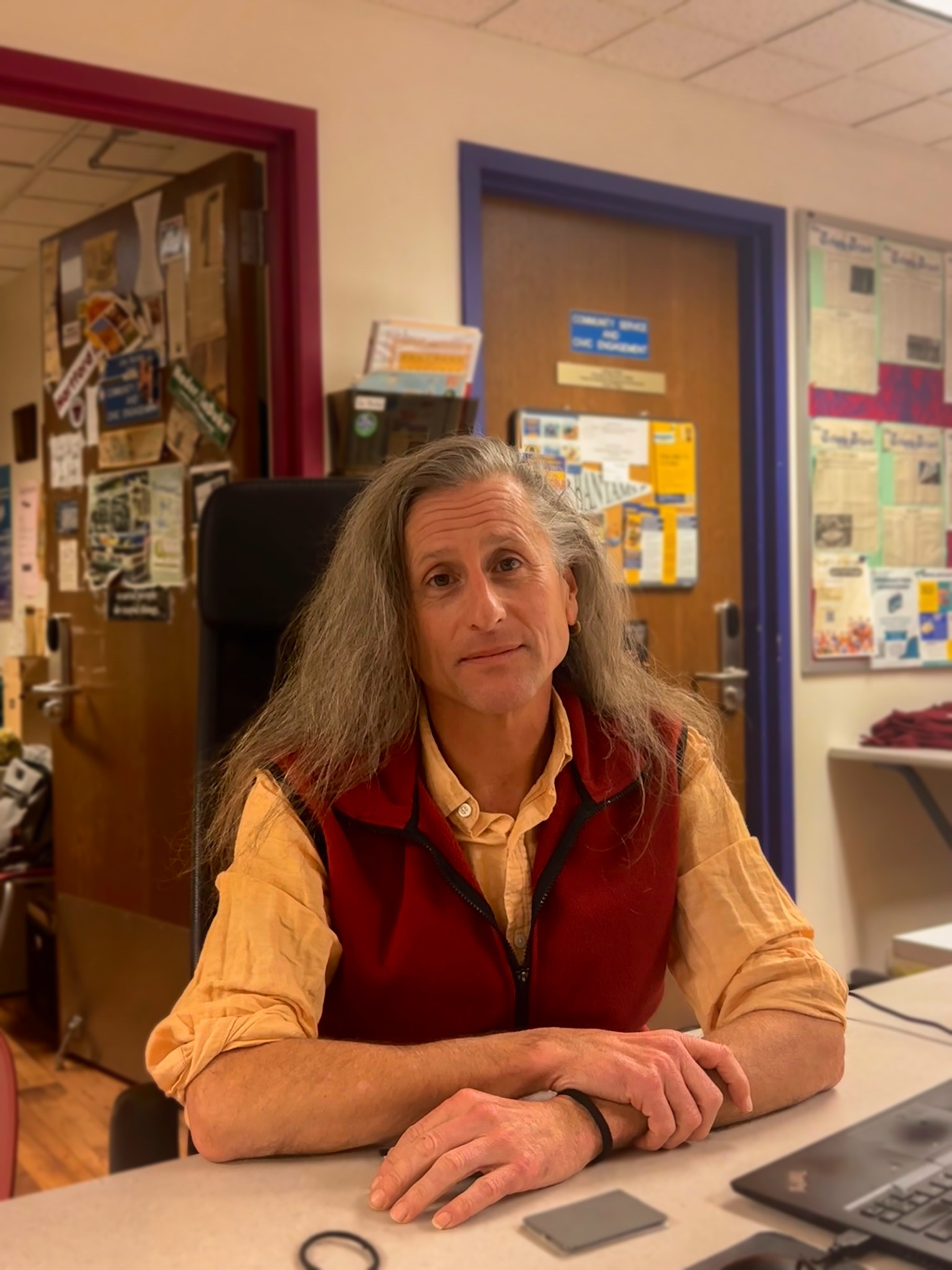
Tucked away in the basement of Mather sits the Office of Community Service and Civic Engagement is where you’ll usually find Joe Barber, the office director. Barber has worked at Trinity for 29 years and has lived in Hartford for 30, yet what defines his presence isn’t the length of his tenure; it’s the way he has built a culture of care, sustainability and community partnership on campus.
Barber’s path into environmental work began long before Trinity, back when he was a student at the University of Connecticut. “I got my undergraduate degree in sociology, got my master’s in public administration,” Barber said. “While in college, I think it’s fair to say I was a peace activist. I was in a group called Students for Peace and we worked on education and awareness about various issues at the time, like elections in Central America and the end of apartheid in South Africa.”
After graduating, Barber spent several months on the road, traveling across the country and living out of his car. He held odd jobs before returning to Connecticut where he joined AmeriCorps to work on an urban water-quality project in Hartford, and eventually, Trinity, where he first found a desk in what was then the Connecticut Public Interest Research Group office. Around the same time, he moved into his first apartment in the West End for four months, and shortly after into an apartment where the current Crescent Townhouses sit. That move changed the trajectory of his whole life.
“I didn’t have to worry about driving 45 minutes back home,” he said. “I could spend more time working with the students or getting to know Hartford,” which he swiftly fell in love with.
He also fell in love with its people. One of his earliest, most formative moments came when he attended a neighborhood meeting about quality-of-life issues such as speeding, dumping and housing conditions, and listened to residents strategize passionately about their community.
“I was wicked impressed,” Barber said. “I was, like, these people really care about their community. They’re not moving to the suburbs, they’re not going to be part of the problem. I was really inspired by these folks. I wanted to work with these people.”
When his AmeriCorps term ended, he was unemployed and living near campus. It was a chance encounter outside Mather (being introduced to the new community service director) that led him to a temporary graduate-assistant position in the office, where he stayed.
Barber arrived during a moment of large-scale institutional change. President Evan Dobelle had launched an ambitious vision for community partnership. The Learning Corridor was still in development. Campus events brought major cultural and political figures from Angela Davis to Tito Puente to Martin Luther King III.
“It was exciting,” Barber said. “I had no power or anything so I didn’t know what my involvement would be, but I wanted to be here.”
Meanwhile, he began shaping the office into what it’s become today. “I tried to make the community service office a space that anyone could come into,” he said. “There’s a very broad view of what community service is. It isn’t just feeding meals or tutoring kids, but having a more expansive view that can include such things as working on human rights with Amnesty International or having a non-profit movie theater and starting a film festival. It is, as I always say, service to the democracy.”
Barber also began two of the college’s most recognizable sustainability and access initiatives: the Bantam Bus Pass and the campus thrift shop, the Coop.
The Bantam Bus Pass, launched in 1999, allows students to ride CTTransit buses for free. Inspired by the University of Connecticut’s “Willy Bus” system, Barber pitched the idea early in his Trinity career and worked closely with the SGA to make it a reality — now, it has been running for 25 years.
“I’m amazed that I had the audacity to do it,” Barber laughed. “But when I got here, I said, you know what? We need to do something about mass transit because Trinity is pretty well-situated, but no one takes the bus.”
The Coop began later, in 2010, but grew out of Trinity’s earlier move-out collection program. Originally called “Dump and Run,” it started in 2005 with a chaotic attempt to rescue usable items from the end-of-semester waste stream. Barber remembers the early years vividly: boxes stacked to the ceiling, narrow paths carved between microwaves and mini-fridges, a burst pipe that revealed just how much unnecessary junk had accumulated.
The Coop now operates as a fully student-run sustainability and affordability initiative. Students decide what goes on the shelves, while the majority of donated clothing (nearly 4,000 pounds this past year) is passed along to Goodwill and Savers. The revenue the Coop brings in is directed to Hartford organizations chosen by Coop managers.
When asked what makes him stay engaged with the office, Barber immediately pointed to relationship-building. “I can’t do my job without the students. They can’t do their job without me,” he said. “To work with young, smart, energetic, caring, empathetic college students, it’s a joy. We work at a college where people are literally living their lives. They’re studying, they’re learning new things, they’re falling in love, they’re falling out of love. They’re challenging themselves intellectually, physically. What a cool time to be involved with someone’s life.”
“As I get older, I have to be even more humble about what I know,” he added. “I’ll ask students to explain things to me all the time. And it’s funny because they could make fun of me, but they’re usually very gentle. And that’s very lovely.”
After 29 years, the hardest parts of the job aren’t burnout or bureaucracy; they’re the fleeting nature of time with students.
“You got three years and nine months punctuated by all the things that happen within the life of the college,” Barber said. “You need to be aware that you can’t really fight the calendar.”
Still, what sustains him is simple: gratitude.
“I’m really fortunate to have this position,” Barber said. “The way I got this job, are you kidding me? I was in the right place at the right time, quite literally. And I like to think I’ve done a lot of good stuff for Trinity, and I like to think that I’ve done some decent stuff in Hartford too, both in and outside of my job. And in so many ways, Trinity’s made my life in Hartford possible. I’ve met so many wonderful people, done so many cool things here. I don’t know if I’ve ever had a dream job. I just feel like I’ve been really lucky to be in this one.”


go Joe!