





Alex Gervais ’28
Exec. Opinion and Design Editor
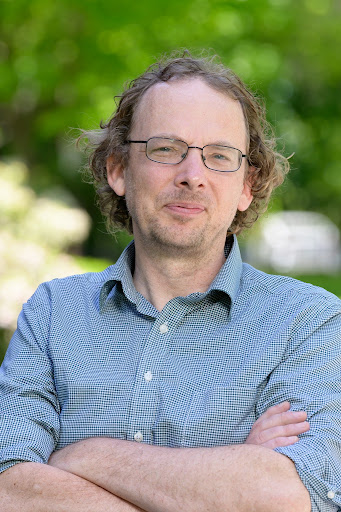
In the winter of 2025, Trinity Professor of History, Scott Gac was looking forward to spending four months at the University of Calgary as a Fulbright Scholar. Professor of History Scott Gac has been at Trinity College for two decades. He teaches courses on American history, race and cultural memory. He recently published “Born in Blood: Violence and the Making of America” and continues to research Trinity’s historical ties to slavery and white supremacy as a co-founder of the Primus Project. The Fulbright program, which Professor Gac was supposed to join, was started in 1946 by the federal government with the goal of intellectual cultural exchange. It’s long been one of the more prestigious and impactful grant awards in higher education and Trinity itself consistently produces award winning scholars.
Yet, Professor Gac’s grant to do research abroad was taken away by the Trump Administration. The Tripod sat down with Professor Gac to reflect on his story.
In late 2024, Gac “got a notice from one of the directors at Fulbright Canada that said, ‘you are the finalist for the award. This is not an official announcement.’” It seemed that he was positioned to be a Fulbright scholar: “The process is very pro-forma, once you’re chosen, everything just has to come in. And one of the things that has to come in is that the State Department has to grant you your grant papers. They have to say, this is legit. And that’s exactly where everything hit the fan.”
Just weeks later, Gac received an official notice from the State Department telling him he had been denied the award. “I started to have conversations with the people that I had been in touch with at the University of Calgary, and they’re just like, ‘I can’t believe this is happening. This is crazy.’”
Gac was one of nearly two hundred US scholars who had their awards rescinded by the Trump administration because of the topics of their research, culminating in the entire Fulbright board resigning. Gac had planned to do research into race in early American democracy: “I was curious about the removal of the right to vote from Black men in 1818 by the Connecticut Constitution and trying to understand early American democracy through this northern Connecticut lens. It was kind of right in my wheelhouse in my current work.”
In the wake of his Fulbright being rescinded, Gac contacted the Office of Congressman Joe Courtney, asking to pull his State Department Fulbright application file. Yet “the State Department claims there’s nothing there. There’s no file. There’s nothing to see. And so you start to try to avoid a conspiratorial mind. But it’s tough not to.” For Gac “part of the frustration is that it’s done relatively in secret behind some closed door. You get a very generic message sent from the State Department that basically says ‘don’t contact us.’ Like ‘we can’t talk about any of the decisions.’”
It’s difficult to understate the impact a Fulbright can have for a scholar: “these are somewhat once in a lifetime opportunities for somebody at a liberal arts college. We don’t have as many research opportunities as people at an R1. So when you get them, it’s kind of a big deal.” The award is “about international exposure, it’s about conversations, it’s about international intellectual exchange that gets infused into the classroom. I’m a better scholar if I have those conversations. I can’t necessarily have those conversations as in-depth as I could if I was at the University of Calgary for four months, that’s different than sending some emails to ask somebody a question. I’m a human, I work in humanities, you can’t replace the human exchange.”
For Gac the work has continued, but it feels different than it used to: “a lot of faculty are censoring themselves in some way, shape or form about what we say in class because we don’t want our institution to wind up on a list, we don’t want to wind up in the next headline which may only be for a day but it can resonate for a much longer time. The work I do on race and violence is at loggerheads with the federal administration right now. It’s definitely a navigation between wanting to get the work done but not wanting to get tripped up in a fight along the way because then the work doesn’t get done. So it’s this interesting balance.” He continued discussing balance: “On one hand, you want to take a little bit of a warrior mode and you just want to be the person who is just like, ‘this just doesn’t matter. I’m doing what I’m doing no matter what.’ And it’s true to a point. And then there’s the other point which is just like, ‘I’m constantly in over my head: I lost that award, the book that this will eventually become will be slowed down because I didn’t have four months of grant money to just write, which is what that research book was. So I’ve slowed down, but not stopped.”
He also reflected on the role of community and his students in pushing him to continue: “In the fall, it was my students who actually drew more out of me than, you know, I was more cautious and my students were presenting on topics that I was just like, ‘wow, they went full in to the current administration’ in my class and I was just like, ‘okay, maybe this is a safe space for me.’ That was an interesting moment, I don’t know how to navigate this.”
Gac continues to research, co-leading the Primus Project for which the team recently received an award through the Mellon Foundation and the Council of Independent Colleges. He’ll be researching the Black census in Hartford, continuing to study race in America even as the very nature of his work is under attack by the Trump Administration.
“This is what censorship looks like,” said Gac. “This is an academic freedom issue, but also a freedom of speech issue.”
+ There are no comments
Add yours