





Nick Cimillo ’26
Managing Editor
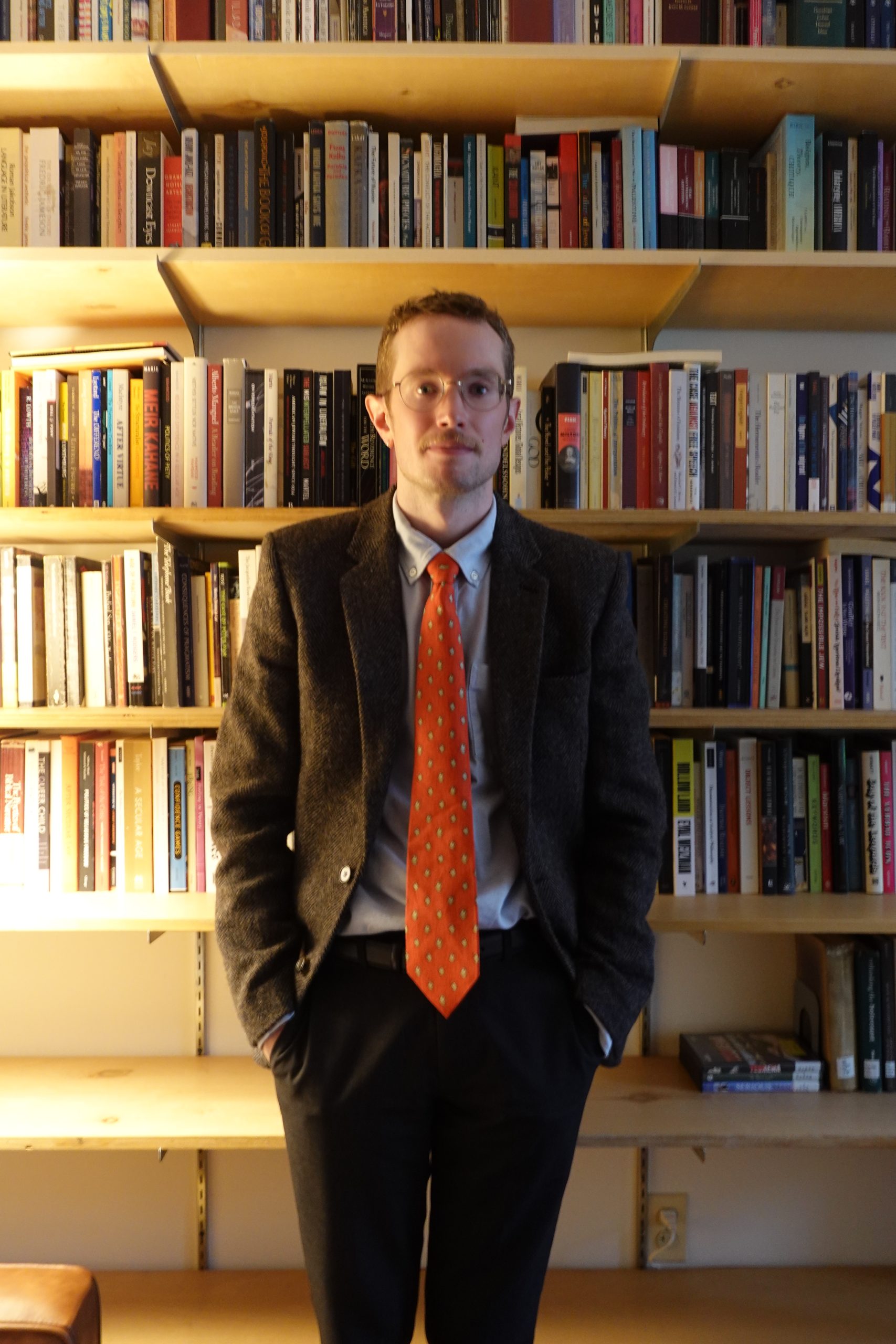
Samuel Catlin, a new assistant professor of religious studies, knows a thing or two about getting academically sidetracked. Drawn to studying the Hebrew Bible during his undergraduate career at Middlebury College, Catlin thought he was set on continuing his study on the history of biblical translation ahead of his graduate career at the University of Chicago. “As often happens in graduate school,” Catlin said in an interview with the Tripod, “I got interested in a bunch of other things.”
“I ended up focusing more on rabbinic Judaism and modern Judaism,” he continued. “Through the courses I was taking, the kinds of things that ended up interesting me led me down a different path.” Despite his change in academic focus, Catlin recalled what drew him to the study of the Hebrew Bible in the first place: “In college, I read mostly European literature and philosophy,” he said, “and one of those texts was the Hebrew Bible, [which] really interested me in part simply because I found the language really compelling. Biblical Hebrew is an incredibly laconic language; [it uses] very few words to express a great deal of intellectual and emotional content. And the contrast between how much is being expressed and how minimally it’s being expressed creates a really dynamic narrative situation.”
Indeed, part of why Catlin got into teaching was so he himself could further his own knowledge of the Hebrew Bible’s texts: “I decided to pursue a career in teaching in the first place because…I really wanted to just understand certain texts better, and I didn’t have enough time in college.” But there was also more to it than that for Catlin: “Learning to read things patiently and curiously, which is most of what I do, is not a skill that’s given to everybody,” he said. “I saw it as something that we needed more people out there teaching students: how to read and understand texts with patience and curiosity, to ask critical questions. It’s what I’ve been doing my whole life, and I wanted to make sure that other people got the same privilege.”
Following previous teaching positions at the University of Chicago as part of his postdoctoral research and the State University of New York at Buffalo as a visiting assistant professor of Jewish thought, Catlin is teaching two classes during his first semester at Trinity: RELG 109 – “Jews and Judaism,” which he calls “the core course of the Jewish studies program. It’s about [how] the Jewish community predates categor[ies] of race and nation-state,” as well as RELG 276 – ‘Parables in Religion and Literature.” “This is more in my specialty,” he added, “which is the intersection of Jewish literature, Jewish religion and Jewish philosophy. The big animating question of the class is: ‘What was it about parables that made them so useful for Jews and Christians in antiquity?’”
“One of the great benefits of teaching at a couple of different institutions is you really do start to understand how different kinds of institutions make different kinds of learning easier or harder,” Catlin added. “One of the things I love about the liberal arts setup is that it really asks students to have their own ideas, to take ownership of the process of learning. The smaller the class, the easier it is to do that…It’s the kind of learning that the type of material I teach lends itself to.”
In addition to teaching, Catlin is also working on his debut book, a project which he calls an examination of “how six US-based literary critics and cultural theorists made use of Jewish texts and traditions in their work as literary critics and literary theorists. What I’m trying to show,” he concluded, “is that the role Judaism and Jewish literature play in the development of fields like gender studies, literary theory [and] post-colonial studies is maybe not central, but nevertheless absolutely important to understanding them.”



+ There are no comments
Add yours