





Lily Mellitz ’26
Executive Features Editor
If you’ve walked across the Main Quad recently, you may have noticed more than just students heading to class. At Trinity, some students have service animals: companions who play a critical role in making college life more accessible.
Most often, these animals are seen in public spaces: a dog sitting calmly beside a desk in class, waiting quietly in the library or weaving through the bustle of a dining hall. But behind those still, steady moments lies a deeper story of care and necessity. Service animals aren’t pets—they’re highly trained partners who help their handlers navigate daily tasks, medical conditions and mental health challenges.
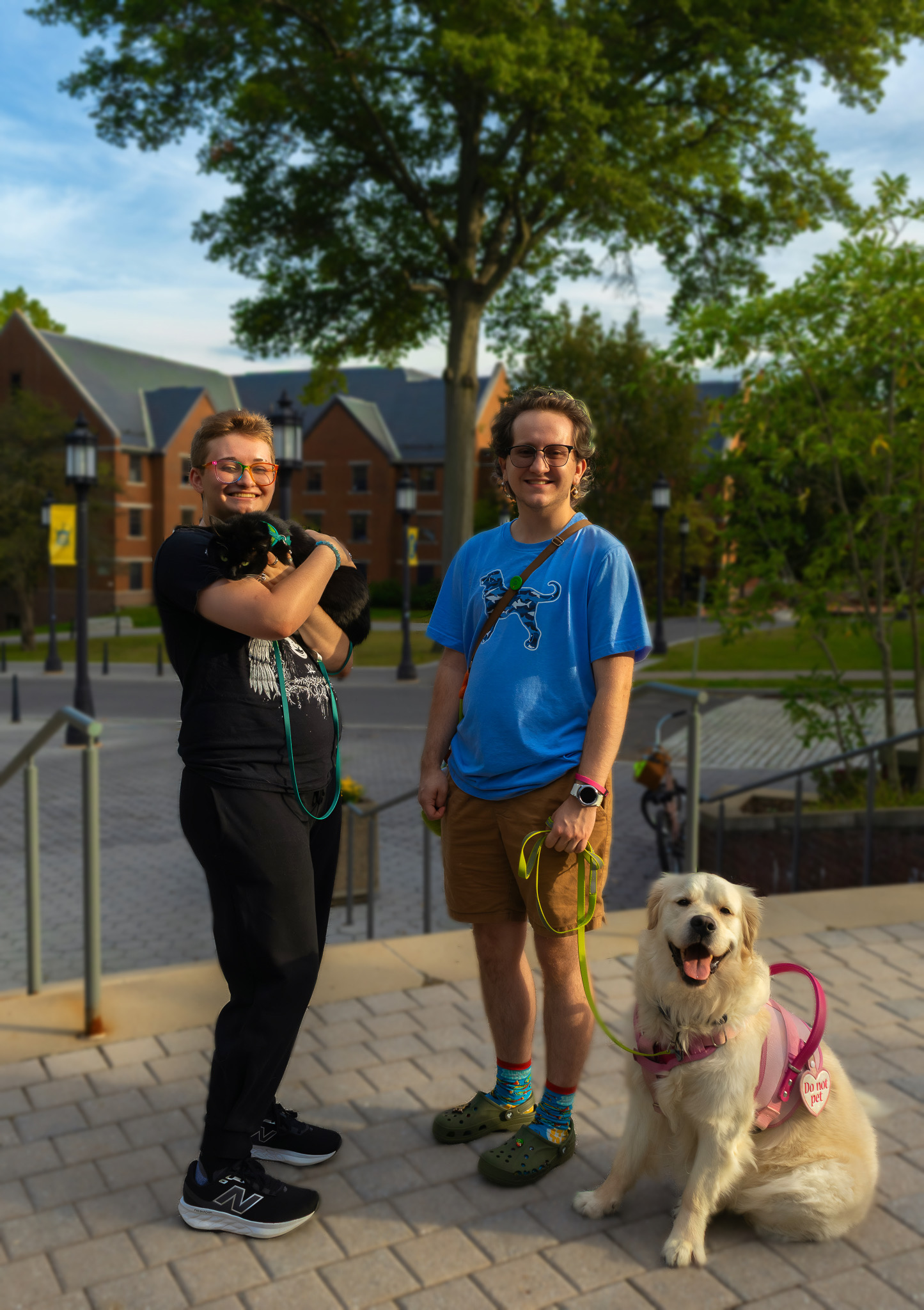
To better understand what life with a service animal looks like on campus, theTripod spoke with two students: Jude Altman ’26 and Leon Dell’Era ’27.
Altman, a neuroscience major from Hawaii and “a proud cat dad,” shared his life with Bell, a black American Shorthair cat.
“I never really expected to have any kind of animal in college,” Altman said. “But my friend Leon asked me to catsit their cat Bell while they were traveling a few times, and I absolutely fell in love with her. Later, Leon was looking for somewhere to rehome her before the summer, and I begged him to let me take her.”
At the time, Altman was struggling with severe depression. Caring for Bell gave him structure and stability when he needed it most. “Getting out of bed to feed her, play with her, and clean up after her, really helps me get out of my depression paralysis,” Altman said. “Taking care of her also means taking care of me. Bell also helps me feel less guilty for taking time for myself and resting when I need to, since I now have to spend a large amount of time at home with her.”
Bell is more than just company—she’s inspiration. “It motivates me to work now that I have someone to spoil, and she is indeed quite spoiled,” Altman joked. “She is an amazing emotional support and cuddle buddy. Her favorite hobbies are sleeping and getting attention, so we love taking naps together and she sleeps with me every night.”
Still, he acknowledged that the responsibility of a support animal isn’t always easy. “I’ve always had cats growing up, but it is definitely different to have the sole responsibility of one,” Altman said. “It can get quite expensive, especially with vet bills. If you’re looking to get a support animal, make sure you can provide for them both financially and emotionally. Some animals are fairly anti-social and might not require that much attention, but others are very sociable and require a lot of time and attention. But if you are in the position to get a support animal, I really recommend it. Bell has completely changed my life for the better.”
Altman also noted that many lack awareness about the role of support animals: “It can be easy to play service animals off or see it as an excuse to have a pet on campus. But Bell is a huge therapeutic support for me and is as important and necessary to managing my depression as my medications or any other interventions.”
For Dell’Era, a psychology major and studio arts minor from central Massachusetts, having a service animal was a decision made with the support of family while still in high school.
“My support team, my parents and I decided that I should get a service animal in my sophomore year of high school, so I made that decision before even hearing about Trinity,” Dell’Era explained. “I was having a difficult time managing my conditions on my own and I was worried about being able to live and function independently. My service dog, Lili, provides the right amount of support, enabling me to be independent and manage my health effectively.”
Dell’Era chose a golden retriever after careful research, noting that dogs are “essentially the only legally recognized service animals.” Lili was then selected from a breeder who specialized in therapy and service work.
“It was challenging to pick out the ‘right’ puppy from the litter,” Dell’Era recalled. “I ended up choosing Lili because she was the bravest of the bunch and checked in on me between playing with her toys, despite being eight weeks old.”
With previous experience training dogs in 4-H, Dell’Era took on the responsibility of owner-training Lili, as permitted by the Americans with Disabilities Act. Since then, Lili has become their constant companion.
“At this point, Lili and I do everything together,” Dell’Era said. “I see her more as a caring and helpful friend [or] partner than as a dog or pet.”
Life on campus with a service animal comes with both benefits and challenges. For Dell’Era, navigating spaces often means finding seats that can accommodate Lili, or managing the distractions of people who try to engage with her while she’s working.
“The biggest challenge, honestly, is having to take her out even if it’s cold, raining, or early in the morning, or if I’m swamped with work,” Dell’Era said. “Last year everything was coated in a thick sheet of ice. Lili didn’t know how to go potty while slipping around, and ABM [Trinity’s facilities’ provider] uses non-pet-safe salt in the winter, which hurts her paws quite a bit.” Fortunately, Lili was able to wear shoes.
“Despite that, she is an overall benefit to my experience here,” they said. Professors and staff have been supportive, with “the ‘worst’ reaction being neutrality,” and many peers light up when they see her around campus.
At the same time, Dell’Era wishes more people understood what it means for a dog to be a working service animal. “As someone with invisible disabilities, I find that a lot of people assume Lili is a pet and not a working dog,” they explained. “I’m happy to let people pet her when we’re not busy, but people will sometimes interrupt us when she’s working. Sometimes, someone will go to pet her or talk to her without even talking to me. Like anyone else, Lili wants to be good at her job and not face extra challenges.”
For both Altman and Dell’Era, service animals aren’t just companions, but lifelines that make it possible to navigate Trinity with independence, stability and a sense of calm. Bell and Lili also serve as a reminder to the campus community that service animals aren’t pets or perks—they’re essential, working partners. Understanding and respecting them makes it possible for all students to fully engage with campus life, in ways big and small, every single day.



+ There are no comments
Add yours