Alex Gervais ’28
Managing Editor
Over the summer, Trinity underwent major campus renovations with some projects continuing into the school year. Among those projects was the renovation of bathrooms in the Jackson, Funston and Jones residence halls, a full rehaul of McCook auditorium, updates to classrooms in Seabury Hall, and the consolidation of student resource offices out of Trinity Commons and into the Library.
The campus also underwent aesthetic improvements, the school power washed many campus buildings including the LSC and MECC, Sol LeWitt’s (American minimalist and Hartford born) wall painting in the Cornelia Center was refurbished and doors on the Long Walk were refinished.
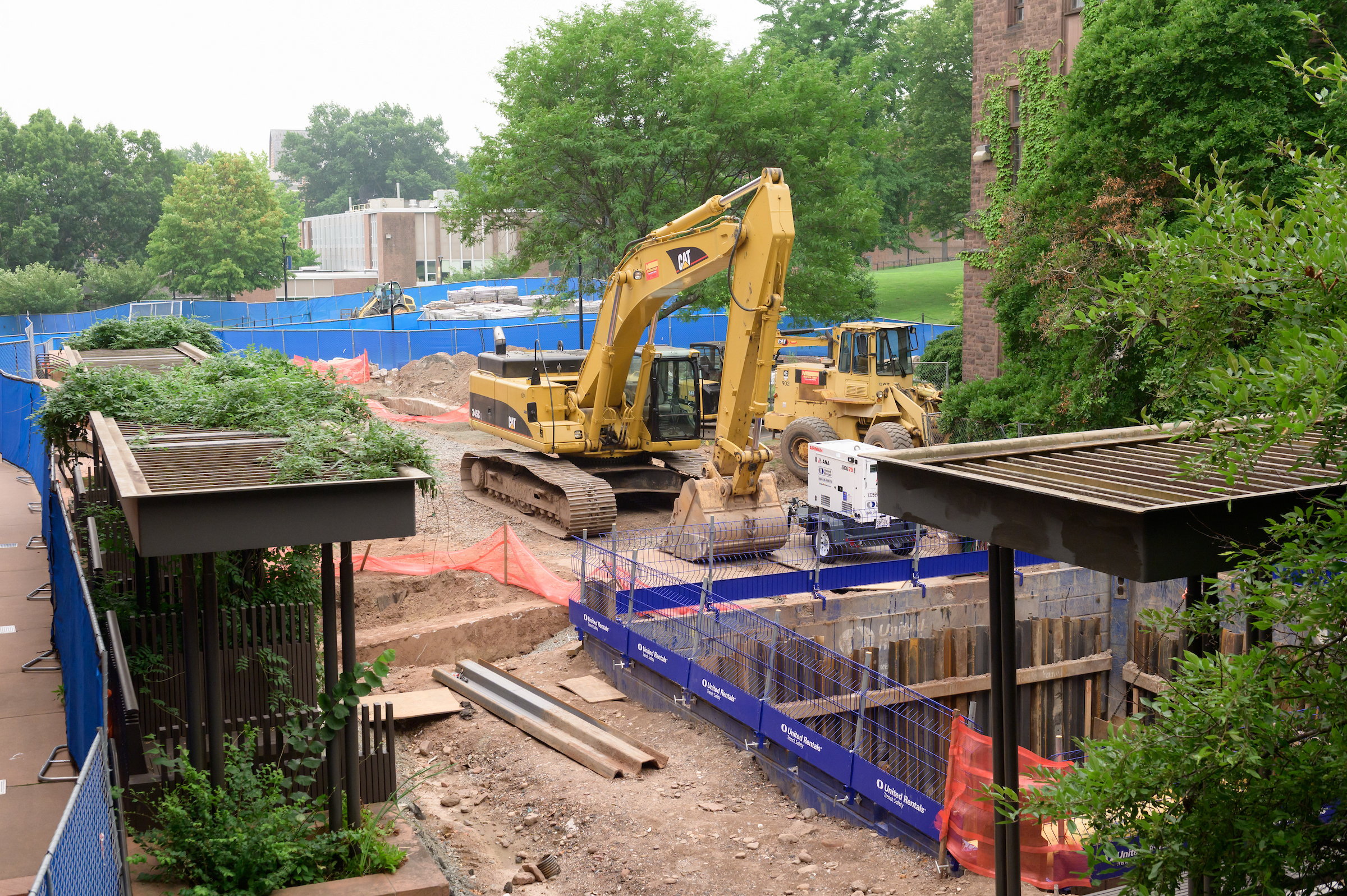
Progress continues in replacing the steampipe that runs in front of the Raether Library and Austin Arts Center, construction currently limiting access to the Gates Quad and some of the surrounding buildings. The pipe has been an area of need for some time, requiring maintenance and even being shut-off for a period of time in December of 2025 after leaks from the pipe created hotter than usual water temperatures in the library. The school hopes to have this project completed by the middle of October.
Construction also continues on the Elting Center for innovation, which is still anticipated to be completed in the fall of 2027 and is being funded entirely by philanthropy. This construction is taking place adjacent to residential communities on North Campus, thus administration included restrictions in their procurement contract about when construction can be done, focusing specifically on protection of quiet hours during Finals Week.
Athletics also saw upgrades to facilities: the Paul D. Assassinate Tennis Center was entirely rebuilt, installing a new post-tensioned concrete foundation. Lighting was installed on the softball field, bringing it into line with the baseball facilities.
These changes represent some of the most visible investments in campus infrastructure since the building of the Scully Center, which opened at the beginning of the fall semester in 2025.
The funding for these changes broadly came from a series of bonds issued by the school in December of 2025, $13 million of that bond funding earmarked for campus improvements. This is a different funding source than for normal upkeep, which is funded generally through tuition payments and some philanthropy.
The Tripod spoke to Trinity CFO Scott Jordan and Rich Majerus, Trinity’s vice president for strategic planning and marketing and communications, to get some context on these campus improvements. They both stressed continuation and stewardship as the thesis of campus upgrades, Jordan saying that “there’s not an end date” to when campus upgrades will be finished, but they’re instead an ongoing process.
Jordan had identified first-year housing as the summer’s priority in an April interview and continued with that theme. He emphasized “welcoming the newest members of our community and wanting them to stay and love it here” as one of the primary motivations behind the upgrades to the first-year residence halls. He also noted that the school has set money aside for a “first impressions” program, where the College will make “fast repairs and improvements” to campus areas of visible need when identified by students or staff.
The pair also highlighted that the facilities team, led by Assistant Vice President of Construction, Facilities, and Operations Tom Fuscillo, who handled the implementation of these changes was primarily to credit for the success of campus changes, highlighting the difficulty of balancing more than a dozen new projects with ongoing normal campus maintenance responsibilities.
Majerus ultimately emphasized that the approach was about care and stewardship of campus, making investments in campus that would last for decades.