





Fields Thomas ’29
Staff Writer
The old cobblestone Long Walk seems to have turned every color of the rainbow overnight. In celebration of Pride, the Queer Resource Center (QRC) held a chalking event to brighten up the sidewalk along the Long Walk and across the quads. From drawings of Garfield to powerful, colorful words of protest, the sidewalk was filled with Pride. At 6 p.m., students met at the QRC with the director, Crystal Nieves, to discuss the rules for the night. Then, the group scattered across campus, carrying buckets of chalk. The students separated to gain more area, first-years heading towards the Long Walk and seniors lingering near the Austin Arts Center.
Chalking has been an ongoing form of protest at Trinity for more than two decades, occurring at least since 1999. Over the years, it has become a cherished tradition within the LGBTQ+ community on campus, with many students participating every year since their first. For the first time in Trinity’s history, however, the chalking event required prior approval due to a recent change in the campus protest policy.
In August, new protest guidelines were released to the student body by faculty and board members. The policy specifies that “expressive” forms of protest must be regulated by place, time, and manner. Chalking was deemed an expressive form of protest—therefore, it now requires approval. Members of the QRC expressed surprise and concern at this change in attitude toward chalking compared to previous years.
When reached for comment, Vice President of Student Life Joe DiChristina shared a few guidelines, emphasizing that freedom of protest is not gone but only regulated. He noted, “We remain committed to freedom of expression. As an educational community, it’s important that we live and learn together with respect and mutual civility.”
Students’ main concern centered on the vagueness of the word “expressive.” When asked to clarify, DiChristina referred to the student handbook, which defines the policy as being guided by a commitment to “open inquiry,” including students’ rights to engage in peaceful expressive activities such as protests, demonstrations, distribution of materials, and hosting speakers. He also cited additional examples of expressive activities, including “actions intended to share beliefs, views, commentary, or opinions, expressed through visual displays, posters, chalking, leaflets, signs, banners, petitions, vigils and picketing.”
DiChristina highlighted that the policy is content-neutral and applies to all forms of expression. He invited students with questions to visit the Office of Community and Student Life, located in the Borges Admissions Center.
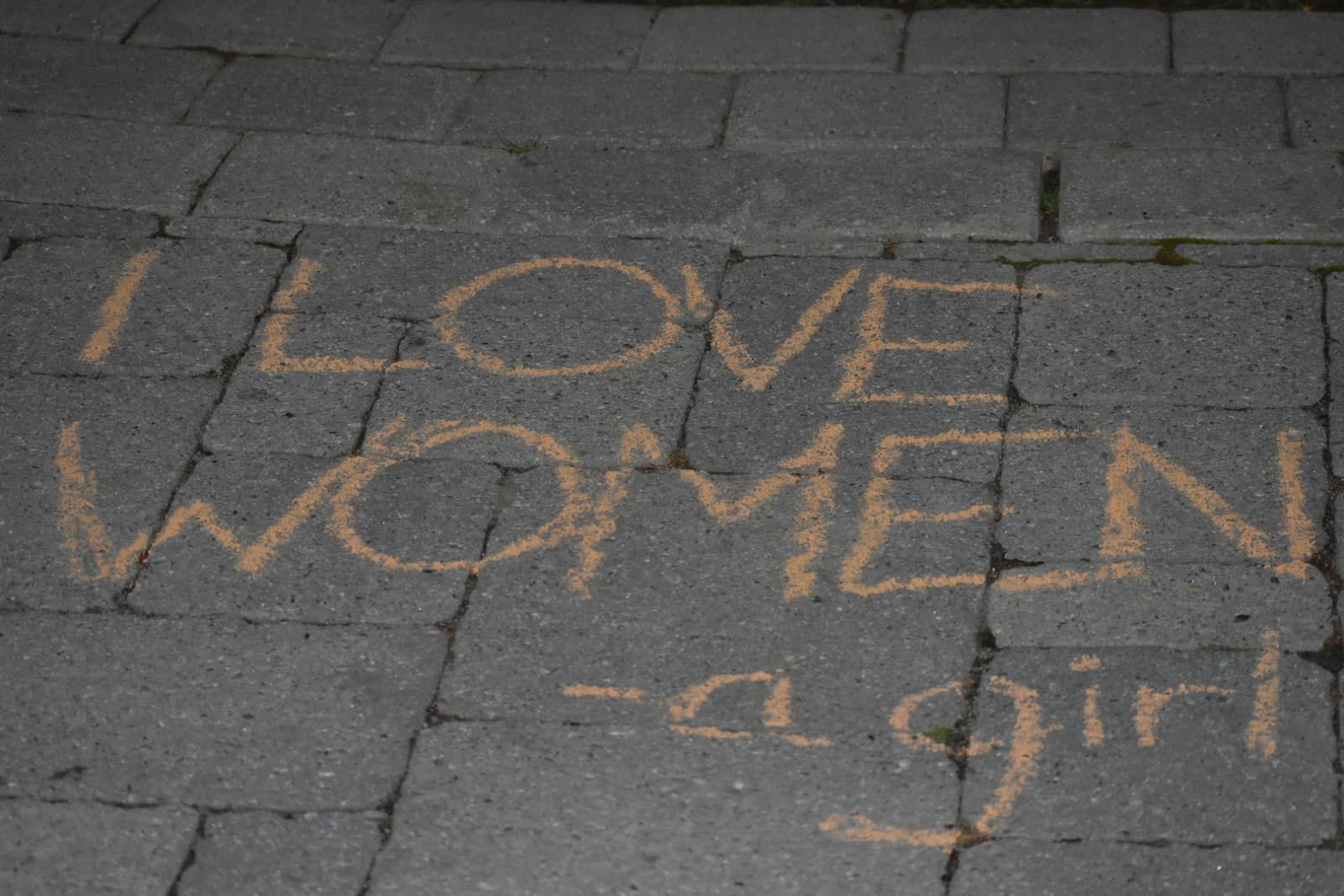
Four-year chalker and senior Lynn Cheng ’26 reflected, “Over the years, chalking has become more political—not because of what we’re writing, but because of the way we’re being treated.” Cheng noted the growing hostility toward queer identities and related legislative changes, adding that “people see it more as a nuisance than as an actual act.” Throughout the evening, Cheng wrote messages such as “Don’t Ban Books” and “I love women—a girl.”
For the QRC community, chalking is not an aggressive or confrontational form of protest but rather a celebration of their existence. Senior Alyssa Hurley ’26 explained, “Chalking for me is all about visibility and being seen on campus. It’s really nice to leave my dorm and see that much support. I know that even though some people might not feel comfortable coming out and chalking, I hope this event helps reach out to them.”
On Monday evening, one message reading “End Violence Against Trans Women” near McCook had been defaced, with the word “trans” scratched out. Cheng noted that the defacing was “pretty common,” and “not the worst thing that’s occurred.”

[…] of the chalking adversely impacted classroom and academic activities on Friday.” Another recent campaign, October’s annual, campus-wide LGBTQ+ History Month chalking led by the Queer Resource Center […]