Aanum Khan ’30
Contributing Writer
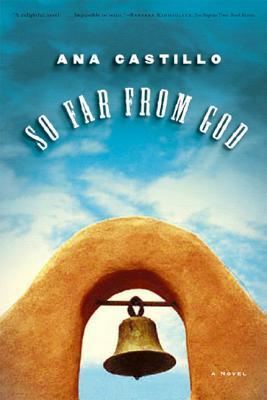
Resurrected daughters, toxic factories, saints and a self-appointed mayor—these are a few of the many peculiarities found in Ana Castillo’s 1993 novel “So Far from God.” I first read this book during my junior year of high school, and I fell in love with it almost immediately. It was unlike anything I had read before, both in its subject matter and in the way it treated the extraordinary as though it were perfectly ordinary.
Needless to say, “So Far from God” is difficult to reduce to a simple coming-of-age or family story. Set in Tome, NM, the novel follows Sofi and her four daughters: Esperanza, Fe, Caridad and La Loca. Each daughter takes a dramatically different path: Esperanza becomes a journalist, Fe pursues the material security promised by corporate work, Caridad discovers a life of healing after surviving a brutal attack and La Loca, who died as a child and returned at her own funeral, grows into an almost saint-like figure. Yet Castillo never allows these characters to become merely symbolic. Their names may roughly translate to Hope, Faith, Charity, and the Fool, but their personalities are far more complicated than those meanings suggest.
It’s easy to approach this book as simply a work of magical realism, but that description does not quite capture what Castillo is doing. In Tome, miracles exist alongside poverty, family conflict, workplace exploitation and political violence. La Loca’s resurrection is treated with nearly the same matter-of-factness as Sofi’s domestic struggles. Caridad’s healing becomes connected to folk medicine and spirituality, while Fe’s illness is tied to the chemicals at the factory where she works. The supernatural does not replace reality in this novel; it becomes part of the way Castillo examines it.
What stayed with me most, however, is Sofi’s transformation. She begins as a woman whose identity has largely been defined by marriage and motherhood. After Domingo gambles away her property, she eventually leaves him and begins building a life that belongs to her. Her independence culminates not in wealth nor status, but in community: she becomes the self-proclaimed mayor of Tome and establishes MOMAS., the Mothers of Martyrs and Saints. Castillo’s feminism is therefore not only about escaping traditional roles, but instead creating alternatives to them.
The novel’s treatment of religion is equally compelling. Castillo draws from Catholic imagery while incorporating Indigenous and Mexican traditions, folk healing, saints and female-centered spirituality. Her characters do not have to choose between being rational and being spiritual, or between inherited religion and their own beliefs. Instead, these traditions overlap, conflict and change. That complexity is one of the reasons the novel feels so distinctly rooted in its setting and culture.
In the end, that’s what “So Far from God” is about: refusing to accept that there is only one acceptable way to be a woman, a mother, a daughter or a believer. Sofi and her daughters are not admirable because they are perfect. They are compelling because they are contradictory. They can be loving and selfish, devout and skeptical, practical and mystical.
Through a family story that is simultaneously political, spiritual, tragic and deeply strange, Castillo asks questions that have stayed with me since I first read the novel. How much of our identity is chosen, and how much is handed to us? What happens when the roles that are supposed to define us become limitations instead? And what might it mean to build a life around other people rather than simply apart from them?
“So Far from God” is not a book I loved because it was easy to understand. I loved it because it gave me something to keep thinking about.
Five stars.