





Kashmala Khan ’29
Managing Editor
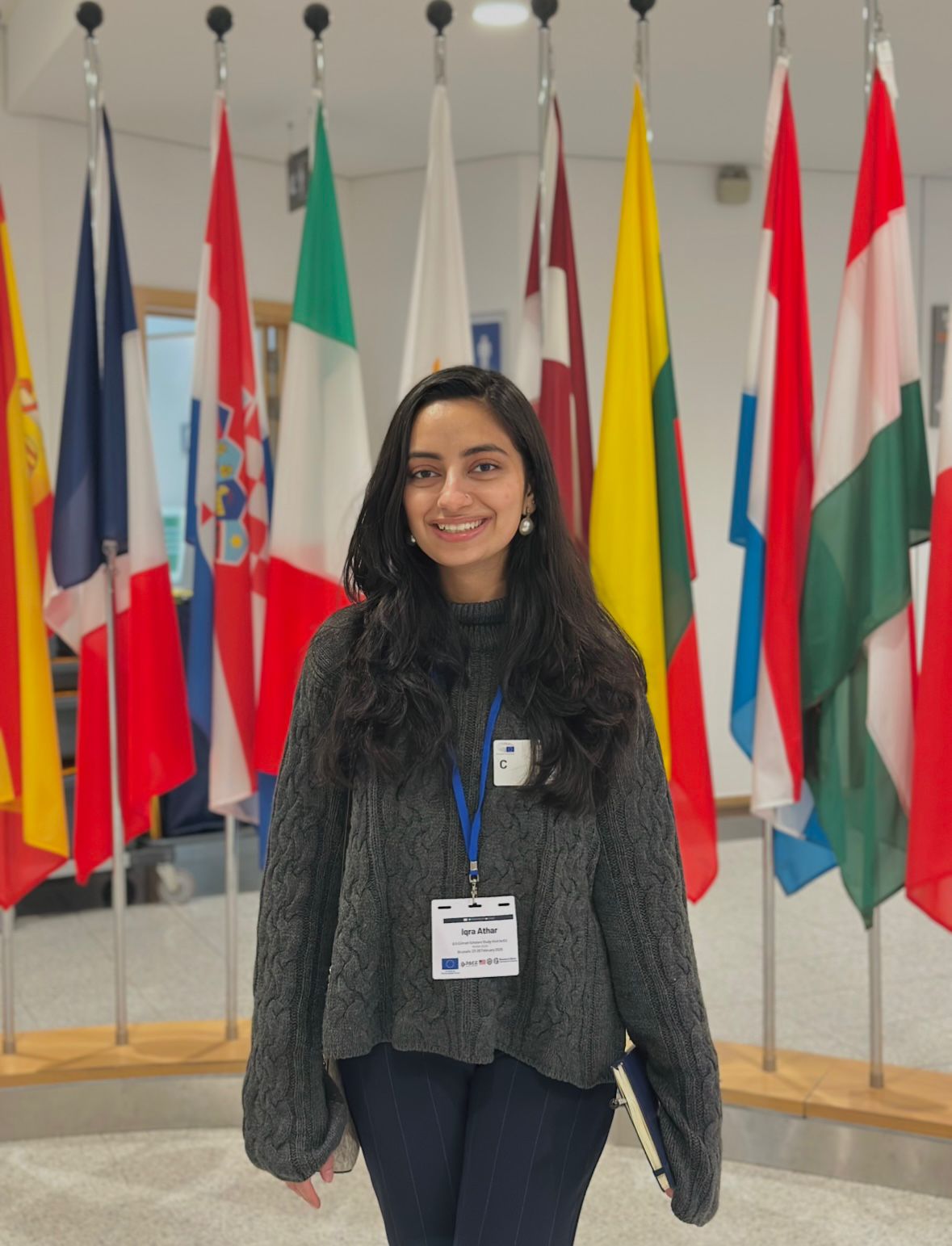
Some people arrive at college with a clear plan, whilst others figure it out along the way. Iqra Athar ’26, did something in between by following her curiosity. In conversation with the Tripod, she discussed how this curiosity was always rooted in something deeper: her family’s story, her lived experiences and the multiple places she calls home.
Athar’s early understanding of the world was shaped by family history. During the 1947 partition of India her grandparents migrated from Haryana, India to Sahiwal, Pakistan “with nothing.” This background entrenched in a struggle for freedom remains central to how she understands stability and insecurity. Alongside that was her father’s pursuit of the “American dream” in the 1980s and her own upbringing in Pakistan during the frequent periods of political and economic instability. Even though she grew up in a relatively privileged neighbourhood in Pakistan, she was always aware of the labor of her family and the realities around her, which were more complex than that surface-level comfort. The starkly juxtaposed struggle and relative privilege became the starting point for how she thinks about inequality today.
Athar first visited the United States in 2016. That transition sharpened her ideologies and interests. “Coming here, you see people don’t fret the same way,” she says, pointing to welfare structures that ease certain pressures. “But you still see a lot of inequality in the U.S.” As she experienced regional differences and various contexts, she developed what she describes as a more comparative lens, which remains a prominent approach in her academic journey.
Prior to Trinity, she felt limited in terms of academic exploration and wanted something broader, therefore she took the opportunities offered by the College seriously. In her first year, she explored widely by taking courses across disciplines through programs like Humanities Gateway and in subjects like theology, neuroscience and women and gender studies.
Economics, in particular, was unexpected. “I never thought about continuing economics in the U.S,” she said, reflecting on how studying economics during her A-levels, much of it remotely, hadn’t been an enjoyable experience for her. But in her second year, she tried it as “a fresh start” and approached it with an open mind. Not only did the subject click, but it also gave her a structured way to analyze the inequalities she had already been observing.
By the end of her sophomore year, she declared a double major in Economics and Political Science, feeling this combination reflects her interests most accurately. Political science allowed her to view systems and governance through a “comparative and globally nuanced lens,” while economics helped her understand financial structures, development and inequality.
However, Athar’s involvement extended beyond academics. In her former role as Executive News Editor for The Tripod, she reported on a range of topics, often focusing on global issues and discussions of belonging as a dual citizen and first-generation college student. She engaged with historical research through her work with the 1947 Partition Archive in California, where she worked on metadata and transcription. Her work also extended into the Hartford community. At the American Place at Hartford Public Library, she facilitated civic education courses taught to young immigrants. She also attended public hearings with Hartford’s Commission on Refugee and Immigrant Affairs and researched non-citizen voting rights with Professor Janet L. Bauer.
“Seeing Hartford and exploring it impacted me,” she noted. “You see how segregated it is.”
These experiences within the city connected her academic interests to lived experiences, as she bridged what she had seen in Pakistan with what she was now observing in the United States.
During her junior year, Athar studied abroad in Sweden as a Gilman Scholar. There, she took classes on international security and had the opportunity to meet European Union policymakers. “That got me thinking about policymaking and how policies work,” she said.
Over time, she also developed a strong interest in student movements, particularly in Pakistan. She became interested in why mobilization in Pakistan appears fragmented compared to other countries. Referencing Anatol Lieven, she points to the idea that Pakistan is “divided, disorganized,” yet still “moves” and remains resilient. For Athar, this raised questions about fragmentation and political participation; these questions also connected to her own civic engagement and advocacy on campus, such as with Trinity Environmental and Climate Justice (TEACJ).
These intersecting interests ultimately shaped her decision to pursue two senior theses.
Her economics thesis, supervised by Professor Betul Mutlugun and Professor Raul Zelada-Aprili, examines Pakistan’s relationship with the International Monetary Fund, asking whether IMF dependency supports long-term growth. She focuses on the trade-offs involved: while such programs may help curb inflation in the short term, they can also contribute to unemployment, reduced public spending and longer-term structural challenges.
On the other hand, her political science thesis, supervised by Professor Sidra Hamidi, takes a comparative approach to student movements in Pakistan. She analyzes the Balochistan Student Organization and the Pashtun Student Federation. She asks, “What motivated one movement to turn insurgent and the other to be more integrated and committed to non-violence?”
At Trinity, she has been recognized as a member of Pi Sigma Alpha and as an 1823 Scholar. Yet when reflecting on her time here, she emphasizes the people around her: “The faculty pushed me out of my comfort zone,” she says, pointing again to Professor Bauer’s mentorship, including work on the Afghan Female Outreach Program supporting Afghan girls in their educational pursuits.
Everything she has done, she says, has been shaped by lived experiences and the framework laid by Amartya Sen that questions: “What is azaadi?”— freedom.
Looking ahead, Athar plans to pursue graduate studies, likely in international relations or political economy, with a focus on development and governance. The intersection of her life’s realities and intellectual discoveries runs through everything she has done at Trinity. It is what drives her questions, influences her research and continues to guide where she wants to go next.

+ There are no comments
Add yours