





Lily Mellitz ’26
Executive Features Editor
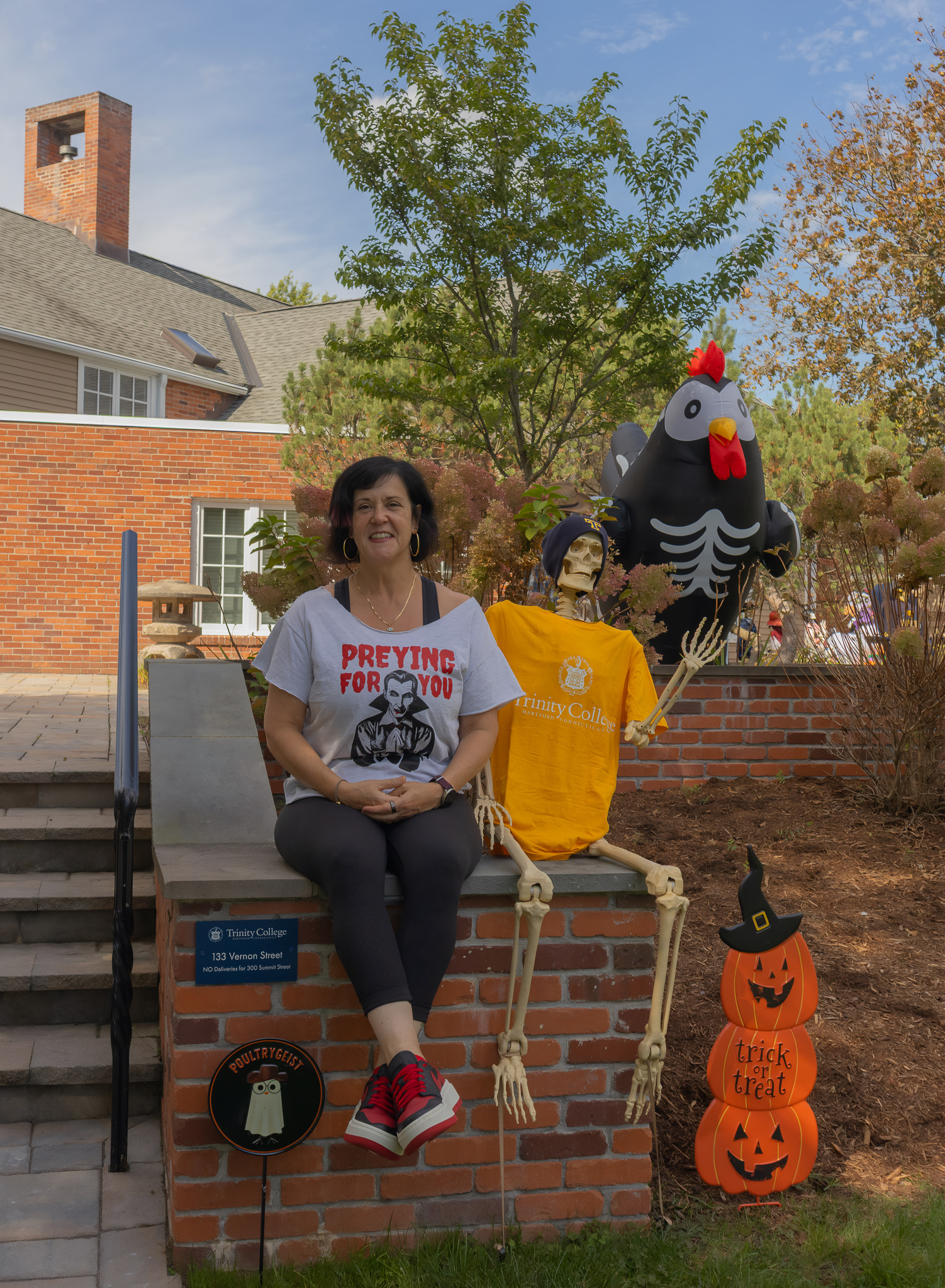
From the moment you see the President’s House this October, the change is impossible to miss. The yellow-walled residence, home to Trinity College’s past and present presidents and partners, has fully embraced the Halloween spirit. Gravestones bearing the names of famous poets and writers rest in the garden, ghostly figures drift spookily from the trees and towering inflatable skeletal roosters stand watch over the front paths. The spirit behind it all is TinaMarie Lugo, wife of President Daniel Lugo, who arrived in Hartford in July and was recently inaugurated as Trinity’s 23rd president.
Mrs. Lugo, who holds a master’s degree in social work, has spent her career working with communities affected by poverty and trauma. Her own story, rooted in a childhood of scarcity and a constant cycle of moving, has profoundly shaped her outlook.
“As a child before I even came to adulthood, we moved thirteen times—and that was mostly because my mom couldn’t afford to pay the rent somewhere,” Lugo shared. “So, you know, you kind of packed up in the middle of the night and you found another apartment, and another apartment.”
When asked if her family history is what inspired her to go into that field, her response was, “a hundred percent—I think everybody gets inspired by that. Seventy-six percent of people who go into social work come from trauma,” Lugo said. “Mine was just poverty. My mom was a single mom with eight kids. So it was lack of money, lack of resources—lack, lack, lack.” Now, as the spouse of Trinity College’s president, Lugo brings that same empathy and insight to campus life, understanding what it means to survive, to heal and connect.
“I think that people don’t get poverty,” she said. “People think you can just wish away problems. But when you’re poor, there’s a trickle-down effect of other problems, like bad health. So, my field of focus and study a lot of time has been nature versus nurture.”
Both Lugo and her husband are first-generation college graduates, which they believe is a defining part of their shared identity in higher education. She spoke candidly about the humility and gratitude that come with upward mobility, as well as the quiet sense of not entirely belonging.
“That just makes us different,” Lugo explained. “People want to talk to you and want to see you as who you are now. I’m very comfortable disclosing I just turned 57. But that isn’t who I was at seven, 17, 27, right? So it’s eye-opening to now live in a more affluent academic circle when I didn’t come from that as a child, because I think I get to offer this beautiful perspective.”
Working in higher education and being first generation themselves, education is everything to Lugo and her husband. “The one promise we made to our children is that they would never have a student loan,” she said. “So, while we were paying back our own student loans, we were trying to figure out ways to pay back their college and their future. It’s been a sacrifice, but it’s been worth it. We value education above everything. It’s power. It is. And the fact that we have a whole movement attacking education right now just breaks my heart.”
When she first moved to Hartford, Lugo was struck by how people spoke about the city, noting, “People either talk too negatively about Hartford or people try to sell it a little too hard.”
She also recalled an uncomfortable encounter at a furniture store shortly after moving. “The store I happened to be shopping at maybe made an assumption that somebody that lives in Hartford doesn’t have the right to have something this nice. And they were just like, is this your delivery address? Yes, yes it is,” she said. “We don’t have a second home. We’re here, we’re part of this community—and I love it. Hartford feels like home. But I think that attitude has surprised me. And it makes me sad in 2025 that we’re still that judgmental about communities of color. And I think that that extends to Trinity too. I’ve noticed that we’re not all equal Bantams, and I wish that everybody was a Bantam first, because we all belong to this campus.”
While her professional life is rooted in social work and social justice, her personality is colored by curiosity (and a bit of mischief). Halloween, she admitted, is her favorite holiday, and not just for the costumes and candy. “I’m a massive horror fan,” she said. “Horror cinema gets a really bad name and I don’t appreciate that, because if you actually watch George Romero’s zombie movies, there is a social message in every one of them that is phenomenal. There’s capitalism, there’s racism. You can learn a lot from horror.”
Lugo’s love for the holiday extends beyond her personal interests. The President’s House is participating in Halloween on Vernon and this Halloween night, the house will open its doors for all students during trick-or-treat night. “I already started buying candy in July for this event,” she laughed. “I want it to feel like fun—and like home.”
As Trinity continues to adjust to new leadership, TinaMarie Lugo’s presence adds a distinctly human note to the transition. She’s not one to shy away from conversations about class, identity or inequity, but she meets those topics with warmth, humor and compassion.
Despite having lived in 37 homes across seven states, she doesn’t see herself as rootless. “Our code word has always been familia,” she said. “Wherever we go, we create family. That’s what keeps you grounded.” That same philosophy guides her approach to life at Trinity. She wants the President’s House to be not just a residence for the president, but a gathering place.
“I want people to feel like they can knock on the door,” Lugo said. “That this isn’t some closed-off, unreachable space. We’re all part of the same community.”


+ There are no comments
Add yours