





Helena Likus ’26
News Editor
On Oct. 20, 2025, Trinity will launch Stellic, a new degree planning and audit tool. Stellic has originally been developed by students at Carnegie Mellon University and has since been implemented at many top institutions in and outside of the United States, including Columbia University, Cornell University and Johns Hopkins University.
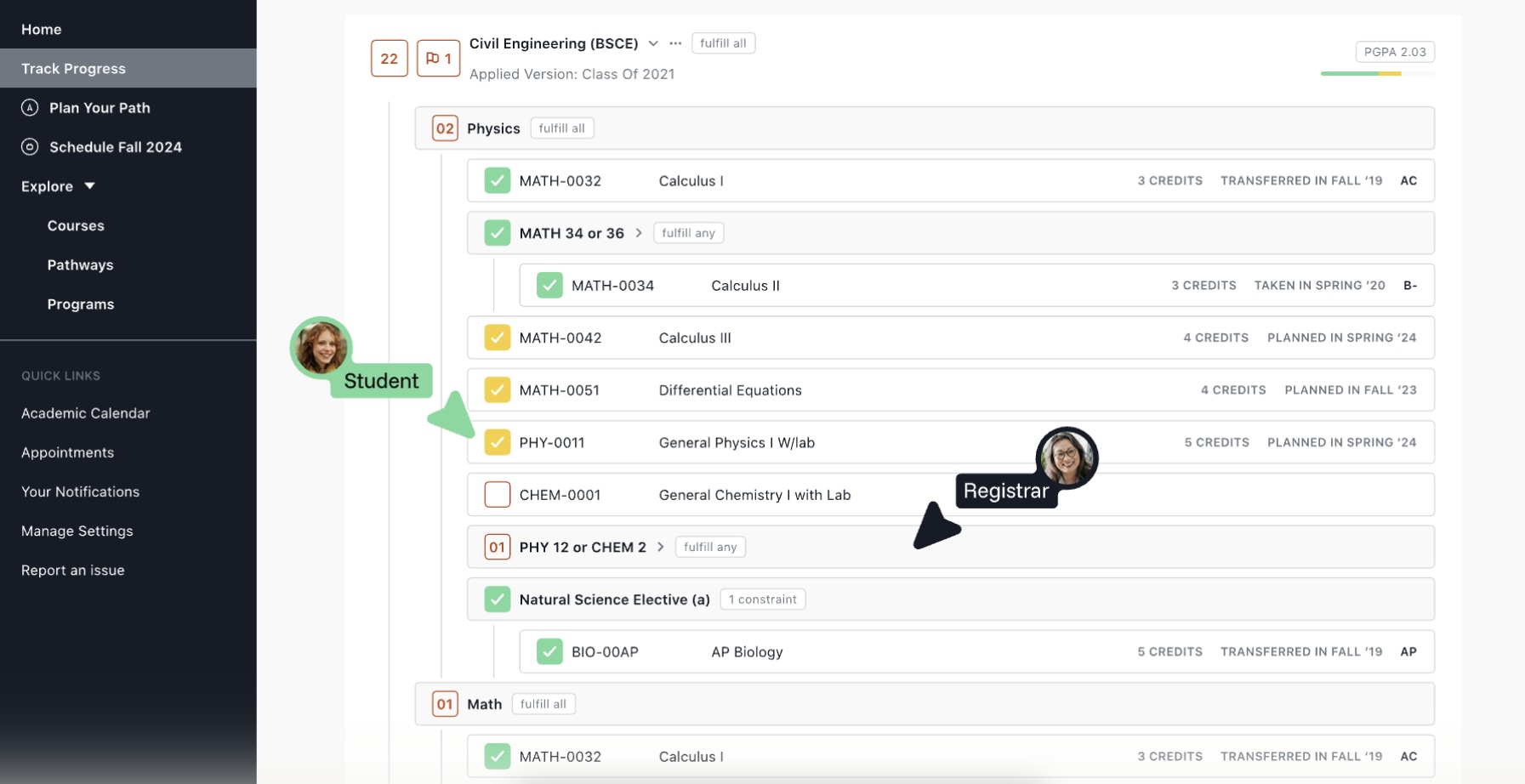
Stellic allows students to see how courses they took and are planning to take fulfill requirements for majors, minors and distribution requirements. It helps students plan their future courses and stay on track with all their requirements.
In a conversation with the Tripod about this tool, Registrar Gabriel Olszewski said, “We wanted to greatly streamline that process, to actually give students a tool that they can use on their own.”
Stellic supports collaboration and exchange of information between students, advisors, the registrar’s office and academic departments. “Degree planning is designed for students and their advisors to track their progress to degree or major completion,” Olszewski continued, “The degree audit is where the departments and programs work with the registrar’s office to see who is on track to graduate.”
It gives students more agency in the process of degree planning. Olszewski said, “Students could try on the major and see what the requirements are like and see how the courses they took will actually apply. They can start to do that exploration a little bit on their own.” In addition, Stellic has functions that go beyond course selection and tracking, though those functions will be implemented later in the year. “There is a notes feature where departments can save notes,” Olszewski added. “Having the notes stored with your profile, instead of having to rely on the advisor passing notes to the next advisor, is going to be really cool.”
In response to a question on why Trinity decided to implement Stellic, Olszewski said, “Trinity only offers a tool to track distribution requirements. We clearly do not cover majors, minors and certificate progress. And without having one, departments have created their own tools to track it. All of those tools are in the department’s possession, and unless they share a copy with you, you can’t see it, and it means you and your advisors are constantly spending time counting courses.”
The process of preparing for the launch was long and difficult. “We were working for more than a year in the background. We got started in August of 2024,” Olszewski said.
However, Stellic is still under development and will continue to be after its launch on Oct. 20. “This is phase one, like a soft launch, because we need the experience of running side by side systems, what the department is currently using with what we are doing now. This phase will probably continue through the rest of the academic year,” Olszewski said.
In terms of where Stellic is at the moment, Olszewski shared, “The thing that we are working on really intensely right now is working with each of the departments and programs to translate what is in the bulletin into the logical framework that Stellic uses to track major requirements. We will have all but one of the top ten majors ready before we go live.” Stellic is also expected to expand to minors and experiential certificates in the near future.
“We are excited about it because I think it will transform advising for the better,” Olszewski concluded. “Students will be able to own their degree progress a little more, and they will have a wonderful collaborative tool to work with their advisors on it.”



+ There are no comments
Add yours