






Sajja Ranjit ’29
News Editor
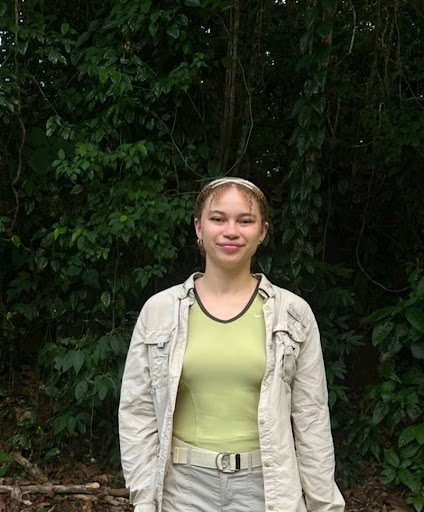
Before arriving at Trinity College, Junny Nguyen ’26 didn’t always see herself as a “science person.” Growing up in Ho Chi Minh City, Vietnam, she remembers an education system that felt rigid and unrewarding. “I thought that I didn’t like to study at all,” she said. “It was more like, if you go to extra classes, you get good grades.” That changed when Nguyen discovered debate in high school. Through it, she was introduced to social science research and eventually, to emotional intelligence, a concept that would shape her academic path. “Mental health is not really discussed in Asian culture,” she explained. “Learning about emotional intelligence was mind-blowing for me.” She went on to conduct her own research on emotional intelligence among high school students in Ho Chi Minh City, marking the beginning of her interest in understanding how people think and feel.
Nguyen arrived at Trinity planning to major in psychology, but her path quickly shifted. After not being able to enroll in psychology courses her first semester, coupled with facing challenges in both biology and chemistry, she found herself unexpectedly drawn towards neuroscience. “Meeting the right professors really changed everything.” Nyugen told the Tripod. She credits Assistant Professor of Neuroscience Michael C. Puljung and the introductory course Chemistry 111 as pivotal influences. “For the first time, I realized I don’t need to be innately smart at something. Hard work can get you there,” Nyugen said. With encouragement and support from faculty, she began to rebuild her confidence in science. Over time, she rediscovered her curiosity and passion, ultimately choosing neuroscience for her major.
That passion has translated into extensive research experience. Nguyen currently works in two research labs, including one led by Associate Dean for Faculty Development Sarah A. Raskin where she studies brain injury patients. She is also completing her senior thesis in this lab where she is exploring an innovative approach to cognitive rehabilitation. While traditional treatments last six to eight weeks, her research tests a condensed intensive four day program. “We’re seeing some promising results so far,” she noted. Reflecting on the process, she described the experience as both challenging and rewarding: “I cried days and nights for my thesis, but I’m proud of myself for getting through it.”
Beyond academics, Nyugen has built a community at Trinity that reflects her personal values and interests. As an international student, she has found connections among peers who share similar experiences navigating language and cultural differences. “They’re like my second family here,” she said. She has also created community through her passions, particularly dance and neuroscience. Dance, in particular, has been a way for her to connect with others and meet new people across campus. She started dancing on campus by joining Elemental Movement Dance Crew, Trinity’s hip hop dance team her freshman year. She also took Dance Ensemble I and II as well as a hip hop class that year. Dance still remains a personal outlet for her now, as it’s something she enjoys doing casually with friends she’s close with. Meanwhile, as the president of the neuroscience club, she has fostered a collaborative environment where students support one another through challenging coursework. “We struggle together and figure things out together,” she said.
Nguyen’s time abroad at the University of Oxford further shaped her academic perspective. There, she encountered a rigorous tutorial system that emphasized independent learning and critical thinking. “My tutor would always ask me, ‘Why do you believe this?’” she recalled. “That’s when I realized even in science, there are so many grey areas.” The experience pushed her to question assumptions and strengthened her writing and analytical skills, which she now applies to her thesis work.
On campus, Nguyen is also deeply involved in student-facing roles, including her work in Trinity’s Admissions Office. Through this, she helps welcome prospective students and share her experience at the college. Additionally, she also works at the Underground Coffee House (UG) Trinity’s student-run coffee shop, where she values the inclusive and community-driven atmosphere. “They hire based on how open you are to contributing to the community,” she said. “Everyone is really supportive and respectful.”
After graduation, Nguyen will continue her academic journey through the Erasmus Mundus Joint Master’s program, a fully funded international master’s degree. She plans to study neuropharmacology in Ireland before continuing her studies elsewhere in Europe. While she remains interested in pursuing a Ph.D, she is open to exploring research further before committing. “I want to figure out what field I really want to go into,” she said.
As she prepares to leave Trinity, Nguyen says she will miss the sense of support that defines the campus community. “There’s support for everything, academics, mental health, everything,” she said. “And you’re constantly surrounded by people who care about you.”Reflecting on her college experience, Nguyen offers simple but meaningful advice to her younger self: prioritize rest, avoid comparison, and embrace challenges. “Don’t stop yourself from pursuing something because it’s difficult,” she said. “We all start from different places. What matters is how much you grow.”


+ There are no comments
Add yours